
I Hired a Company in London Just to Get This Golf Card Game
Some games don’t come easy. Club Golf (Gibsons Games, 1995) is one of them.
It doesn’t ship to the United States. I found it on eBay UK, and the only way to get it in my hands was to hire a package forwarding company in London to receive it and ship it across the Atlantic. This is actually one of three games in that shipment — and every one of them was worth the trouble.
Who Made It?
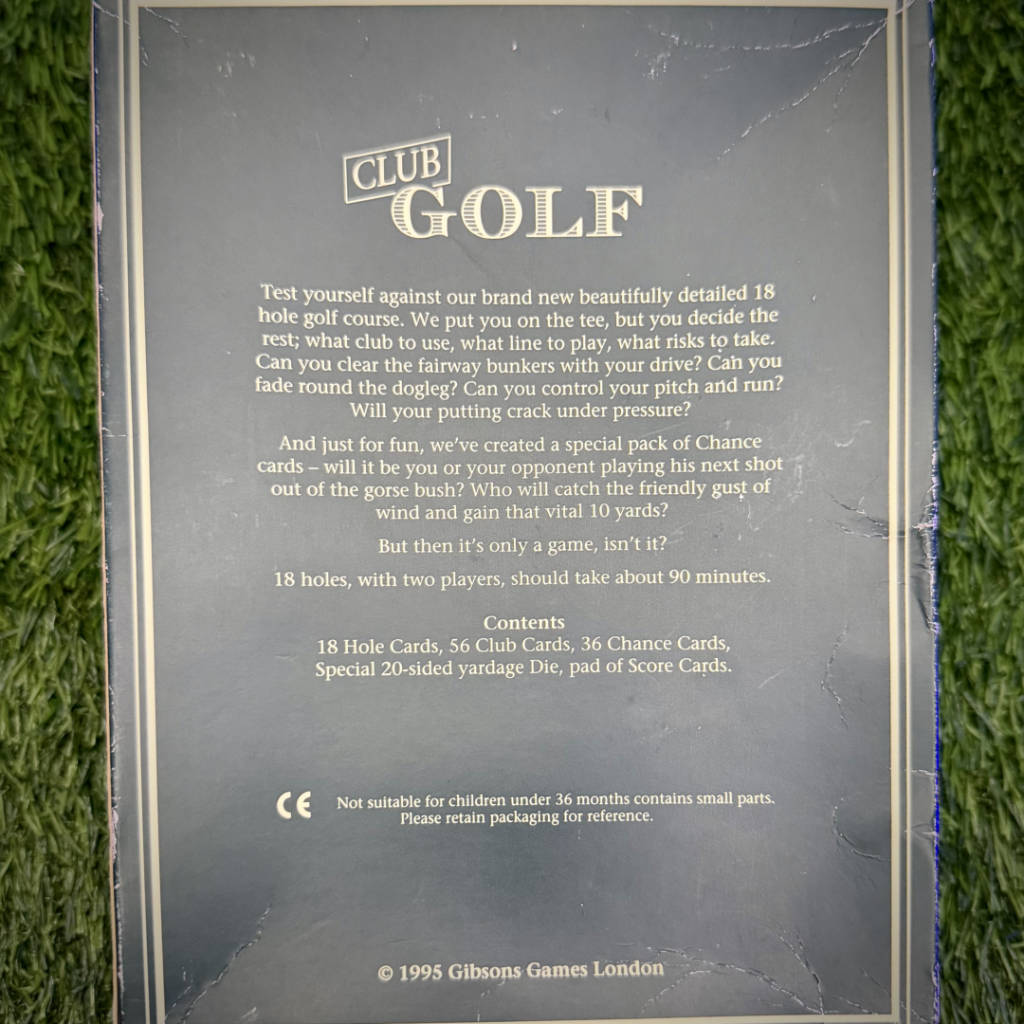
Gibsons Games has been a fixture of British family gaming since 1919. Based in London, they’re known for high-quality puzzles and board games with a distinctly British sensibility — think Monopoly crossed with a Sunday afternoon in the countryside. Club Golf, published in 1995, is one of their most ambitious designs. The copyright on the rulebook reads © 1995 Gibsons Games, London SW19 2RB — which, golf nerds will appreciate, is the postcode for Wimbledon. Appropriate.
What Is Club Golf?
Club Golf is a full 18-hole golf simulation in card form. Not a simplified version of golf. Not a luck-based draw-and-match game. An actual, detailed simulation of a round of golf — where you track your ball from tee to pin, shot by shot, on a fully mapped course.
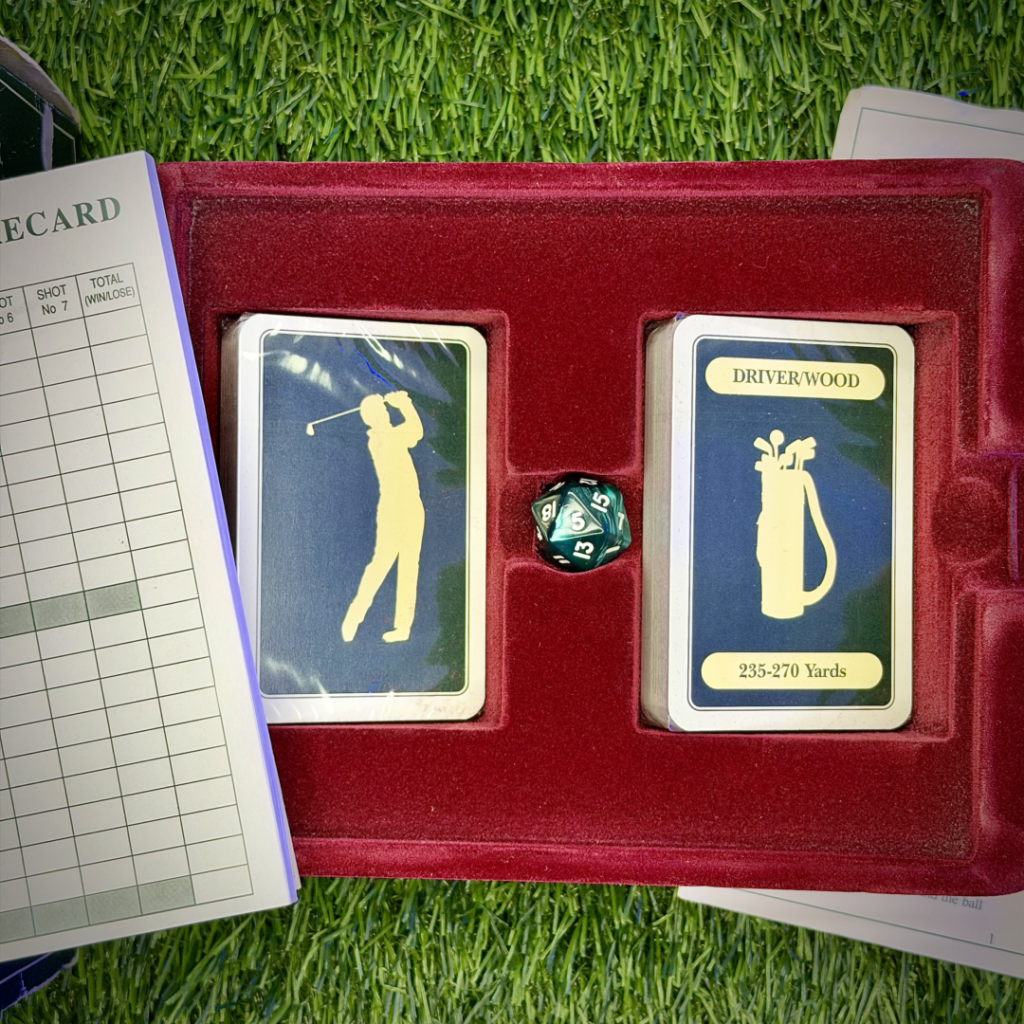
The game includes:
- 18 Hole Cards — each one a detailed layout of an individual hole, showing the fairway, rough, green, pin position, bunkers, water hazards, trees, and yardages from multiple angles. These are remarkable little cards.
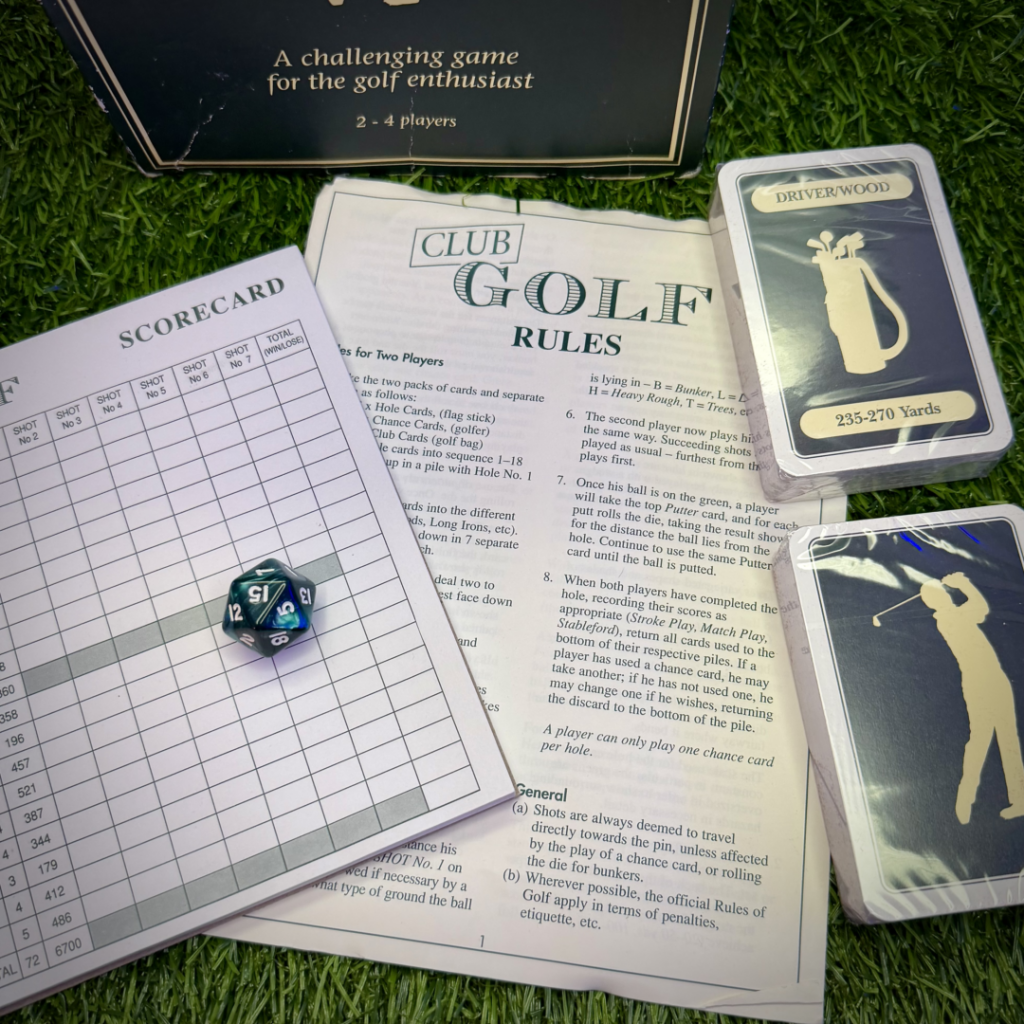
- 56 Club Cards — seven club types (driver, woods, long irons, short irons, pitching wedge, sand wedge, putter), eight cards each. The back shows the club type and distance range. The front shows carry and roll distances for that specific card.
- 36 Chance Cards — split between green-bordered (favourable, modify your own shot) and red-bordered (unfavourable, play against your opponent). One chance card per hole, per player.
- A die, score sheets, and a complete set of rules covering Stroke Play, Match Play, Stableford, Four-Ball, and Foursomes.
How It Plays
The player with the honour chooses a club type, draws the top card from that pile, and plays it face up. The card shows how far the ball carries and where it finishes — but the hole card tells you what’s in the way. Bunker in range? Roll the die. Water hazard? Roll the die. Trees? Your ball stops at the pitching distance and you decide whether to punch out or take your medicine.
You track your ball’s exact distance from the pin after every shot. The further player plays first. Shots out of rough are penalised — heavy rough stops the ball where it pitches, light rough gives you half distance after landing. Doglegs must be played straight unless you have the right chance card. And putting uses the same putter card repeatedly, with die rolls determining whether you drain it, land a gimme, finish one yard out, or stay further back.
It sounds complex — and honestly, it is. This is not a pick-up-and-play game. But for the golfer who wants a proper simulation at the kitchen table, Club Golf delivers in a way almost nothing else in this space does.
The Chance Cards
The chance card system is what gives Club Golf its personality. Green-bordered cards help you — Take Caddie’s Advice lets you redraw a club card you don’t like. Control in the Air keeps your shot on the fairway regardless of obstacles. Hit Pin! works only on approach shots close enough to the green.
Red-bordered cards are played against your opponent — Hooked Into Heavy Rough stops their ball at the pitching distance. Bunkered drops them into the nearest bunker. Topped, Mishit makes their distance determined solely by the die roll, ignoring the club card entirely.
The strategic layer here is real. You’re choosing when to play your card, whether to help yourself or hurt your opponent, and trying to read whether the current hole rewards aggression or patience.
The Verdict
Club Golf is a love letter to the game of golf — complex, detailed, and built for the serious golf fan. The hole cards alone are a work of design craft, packing an enormous amount of information into a small space. The multi-format scoring (Stroke Play through Foursomes) means the game scales genuinely well from two players up to four.
Is it for everyone? No. The rulebook is six pages of dense text. Setup takes a few minutes. You need a table and some focus. But if you love golf and you’re drawn to golf card games, this is one of the finest examples of the genre — and one of the most ambitious designs I’ve encountered in cataloguing over 60 golf card games spanning a century of play.
Worth every penny of the international shipping. 🇬🇧🏌️
Club Golf taught me something important: the more detailed a golf card game gets, the closer it gets to being golf itself — and the further it gets from the kitchen table. There’s a version of this game that can be played in 30 minutes, with no rulebook, by anyone who’s never held a 7-iron. That’s the version I set out to build. Find us at playgtcg.com or on Amazon.
This post is part of our ongoing series exploring golf card games throughout history — from 1926 to today. Club Golf (1995) is part of a three-game shipment from the UK. The other two games will be covered in upcoming posts.