GolfMania (1997): The Golf Card Game That Launched a Billion-Dollar Empire
Every game in this series has been made by someone small. A retiree with a P.O. Box. A weatherman with a PayPal button. Kids from New Jersey. Two guys hiding behind fake names. Small operations, small runs, small footprints.
Not this one.
GolfMania was designed by Christian T. Petersen and published by Fantasy Flight Games in 1997. If you don’t recognize those names, you will in a moment — because Fantasy Flight Games became one of the largest and most influential board game companies on the planet, and was eventually part of a deal valued at €1.2 billion.
And one of their very first products was a zany golf card game with Poodle Love penalties, Drunken Golfer cards, and a rule that required the last player to physically scream “Help!” to forfeit a hole.
The Man Behind the Game
Christian T. Petersen was born in the United States, grew up in Denmark, and came back to Minnesota in 1991 to study economics at St. Olaf College. While still in high school in Denmark, he’d founded a company that imported Avalon Hill games into Scandinavia and helped launch the country’s second gaming convention. The kid was wired for games from the start.
After college, Petersen founded Fantasy Flight Publishing in 1995, initially importing European comics — Lucky Luke, Asterix, Tintin. When the comic business faltered, he pivoted to what he actually loved: games. In 1997, he designed and published Twilight Imperium, an epic science fiction board game that sold 4,000 copies in its first 18 months and transformed Fantasy Flight from a struggling comic importer into a legitimate game publisher.
GolfMania came out the same year. Same designer, Same company, Same pivotal moment. While Twilight Imperium was the game that proved Fantasy Flight could compete in the big leagues, GolfMania was the scrappy little card game riding shotgun — proof that Petersen could do irreverent fun just as well as epic strategy.
What Happened Next
Fantasy Flight Games didn’t just survive — it became a powerhouse. Over the next two decades, Petersen led the company to publish more than 400 titles. The Game of Thrones board game. Arkham Horror. Star Wars: X-Wing Miniatures. Doom: The Boardgame. Star Wars Armada. Descent: Journeys in the Dark. The company became known for premium components, innovative gameplay, and licenses that spanned from Warhammer to Lord of the Rings to Battlestar Galactica.
In 2014, Fantasy Flight merged with Paris-based Asmodee. Petersen became CEO of Asmodee North America. In 2018, he stepped down. That same year, Asmodee was sold for approximately €1.2 billion — roughly $1.35 billion. Fantasy Flight’s performance was cited as a major contributing factor in that valuation.
And it all started the same year as a golf card game where you could play a “Florida Hazard” card on your opponent if they were already stuck in a Big Lake.
The Game Itself
GolfMania is unlike anything else in this series. It’s not a draw-and-swap, It’s not a simulation, It’s not poker with golf suits, It’s a card-and-dice chaos engine dressed in golf clothes, and the instructions are longer than some short stories I’ve read.
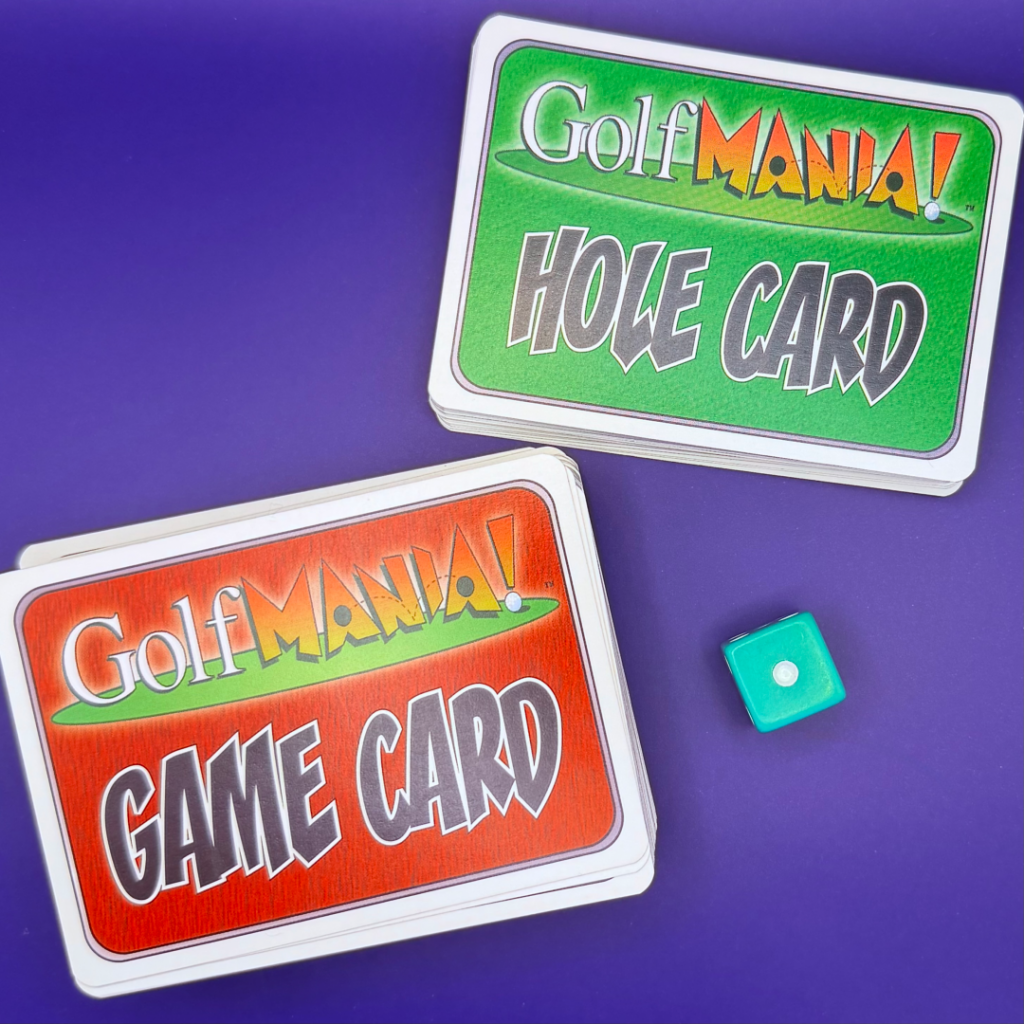
The box contains 30 Hole Cards (with green backs), 69 Game Cards (with red backs), one die, one reference card, and two rule sheets. Players race to accumulate 9 or 18 Hole Points by winning contested holes each round.
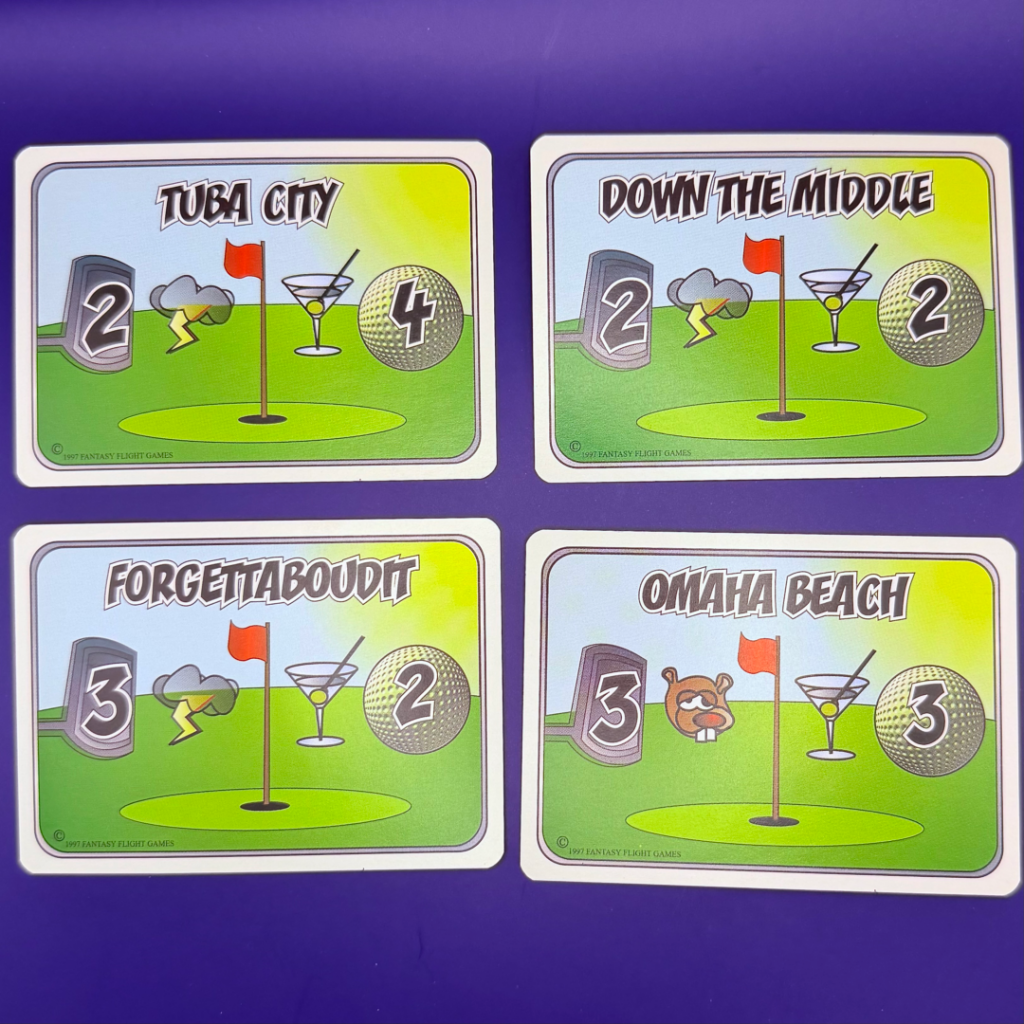
Each round, a Hole Card is drawn — showing its point value, drive difficulty, and which hazard types apply (Weather, Animal, or Social — represented by a thundercloud, a gopher, and a martini glass). Players then attack each other with Terrain and Hazard cards before anyone rolls the die. If you survive the card onslaught, you make a Drive Roll. Pass that, and you make a Green Roll. Lowest Green Roll wins the hole.
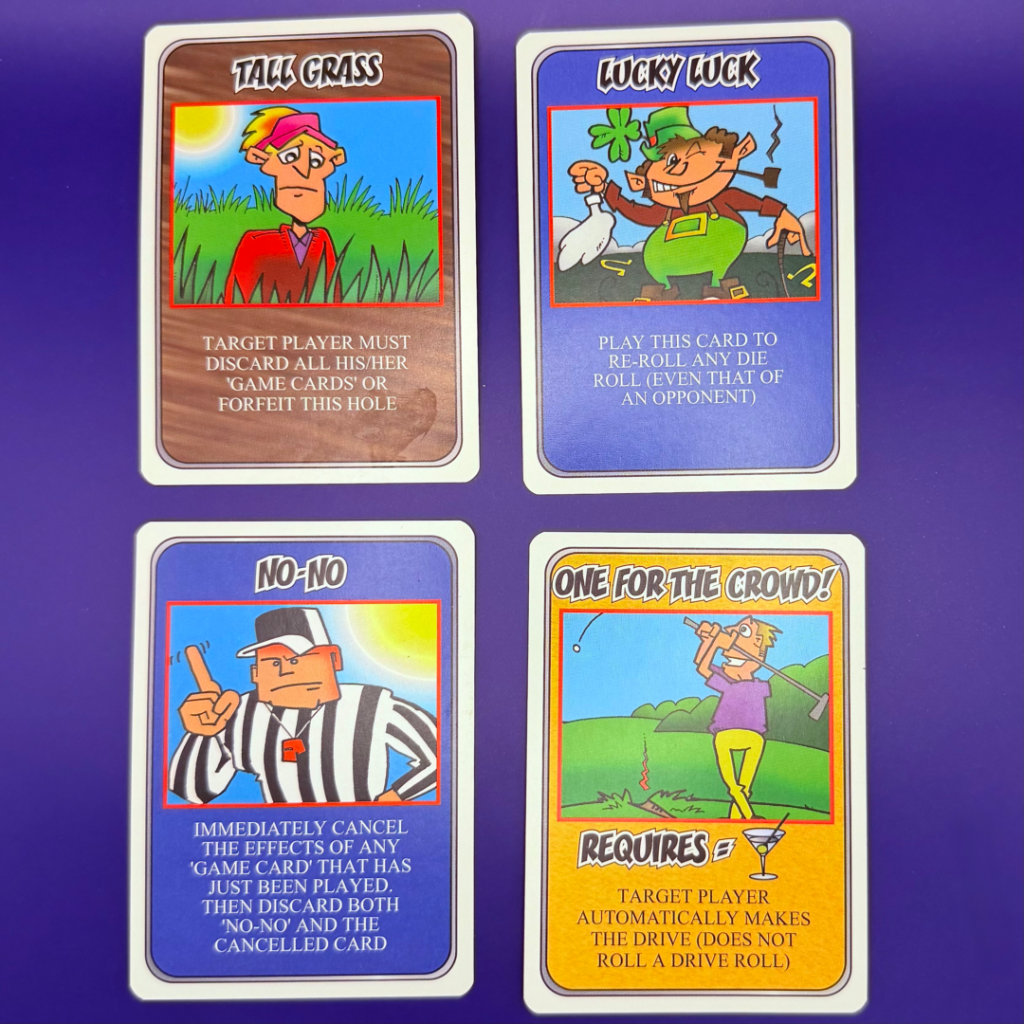
Five types of Game Cards fuel the chaos: Brown Terrain Cards (Sand Traps, obstacles), Yellow Hazard Cards (weather, animals, social disasters), Blue Action Cards (played anytime to modify dice), Metallic Equipment Cards (permanent gear that stays with you), and Red Stress Cards — because in GolfMania, stress is actually good.
The Cards That Make It Wild
This is where GolfMania earns its name. The card list reads like a comedy sketch written by golfers who’ve had too many drinks at the turn:
Poodle Love: Afflicted player adds +1 to all dice rolls until they can play a Stress card to kill it. It can follow you from round to round. Obnoxious Neighbor: Adds +1 to all Green Rolls until you roll an unmodified 1 — could take several rounds. The Nasty Flu: Adds +1 to all rolls, but rotates to the next player if you roll a 5 or 6. Roll a 1 and it’s cured. Drunken Golfer: Last player to physically knock on the table forfeits the hole. Lost in the Rough: Last player to shout “Help!” out loud forfeits. The rules specifically note: “Please do not alarm neighbors, parents, or the authorities with this practice.”
Golf Steroids: Gives you -2 on your Drive Roll (powerful), but if you roll an unmodified 6, you lose all your Hole Cards. Successful Cheat: Roll a natural 1 and steal a Hole Card from any opponent. Heaven Sent: Redirects any card played against you back at the player who played it.
It’s maximum chaos with just enough strategy to keep it from being random. The Equipment cards (you can only have two at a time) force real decisions. The Hazard cards create table talk and negotiation. The physical reaction cards (knock on the table, shout “Help!”) turn it into a party game. It’s a game designed by someone who understood that games are fundamentally social experiences.
The Most Instructions in Golf Card Game History
I’ve cataloged vintage golf card games from the 1920s to the present. I have never — not once — encountered a golf card game with this many rules. Two full instruction sheets. Individual card clarifications. A reference card. Timing rules. Disagreement protocols. The instruction set for GolfMania is longer than some of the games in this series combined.
But that’s the Fantasy Flight DNA. Even in 1997, before the company had found its identity, Petersen was already building games with layers — games that rewarded repeat play and table conversation. The complexity isn’t a bug. It’s the earliest signal of what Fantasy Flight would become.
The Origin Story Nobody Talks About
Here’s what fascinates me. When people tell the Fantasy Flight origin story, they start with Twilight Imperium. Epic. Grand. Strategic. A game that announced a company with ambition.
Nobody mentions GolfMania. It’s the footnote. The other game from 1997. The one with the gopher hazards and the Poodle Love cards.
But GolfMania shows something Twilight Imperium doesn’t: range. Christian Petersen could do sci-fi empire-building and he could do a 20-minute party game about a sport he clearly found absurd and wonderful in equal measure. That versatility — the ability to work at both ends of the complexity spectrum — is what built Fantasy Flight into a company that could publish Arkham Horror and Star Wars in the same catalog.
GolfMania is a footnote. But it’s a footnote in a billion-dollar story.
Finding One Today
GolfMania surfaces on eBay periodically, usually in the $10-$20 range for complete copies. Given Fantasy Flight’s collector following, sealed copies may command more. It’s not rare in the way that a KWG deck from North Dakota is rare, but it’s rare in the sense that almost nobody connects it to the Fantasy Flight name. If you’re a board game collector who doesn’t know this exists — now you do.
From Chaos to Cards
GolfMania is the loudest game in this series. It’s chaotic, social, physical, funny, and deliberately over-the-top. It’s the polar opposite of the quiet, methodical draw-and-swap games that make up most of this collection.
Golf the Card Game lives in a completely different space — streamlined, fast, family-friendly, with the Fore! Card, Wild Cards, and the Mulligan creating strategic moments without needing two rule sheets and a reference card. But I respect the ambition of GolfMania. Christian Petersen didn’t make a golf card game — he made a party disguised as a golf card game. And then he built one of the biggest game companies in history.
Every game starts somewhere. Even billion-dollar ones.
Find us at playgtcg.com or on social media.
This post is part of our ongoing series exploring golf card games throughout history. From P.O. Boxes to billion-dollar empires, the love of golf at the table has never faded.