Hole in One Golf Card Game (1985): The Canadian Club in the Collection
I grew up in Buffalo, New York. On a clear day, I can see the Canadian side of Lake Erie from my window. Canada isn’t a foreign country to us — it’s the other side of the Peace Bridge, a 20-minute drive to a different currency and a different set of road signs. As a kid, going to Canada was just going to the other side. I remember seeing Hole in One Golf Card Game at Crystal Beach.
So when I found the Hole in One Golf Card Game — a yellow box with red and black trim, bilingual rules in English and French, and “Made in Canada / Fabriqué au Canada” printed on the back — it felt familiar. I remember seeing this game when I was young. It might have come from a trip across the border. It might have been on a store shelf somewhere in Western New York. Either way, it’s a game that could only exist in Canada.
The Hole In One Card Game on the Table
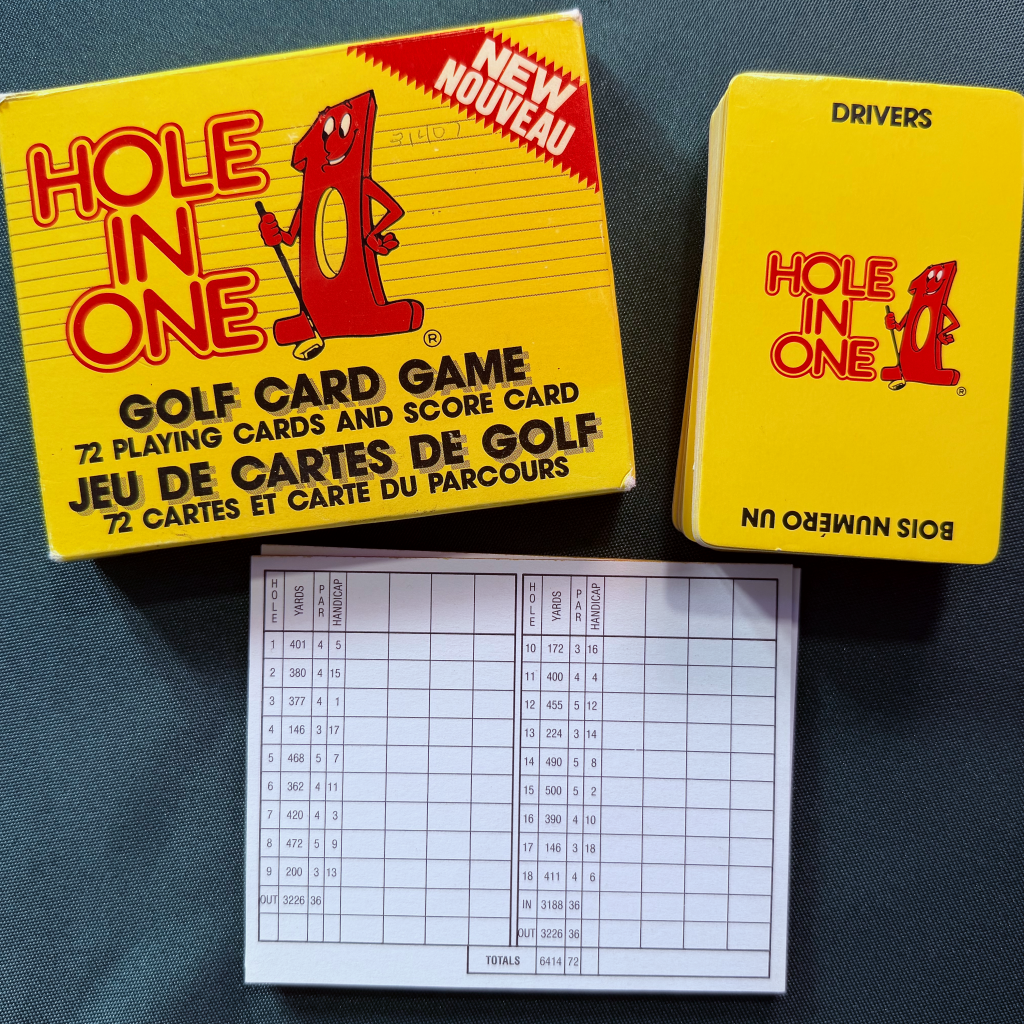
Hole in One was published in 1985 by Hole in One Inc. out of Toronto, Ontario. Some listings also credit a company called Active Communications. The box holds 72 yellow playing cards representing different golf clubs, a score card pad, and the rules printed right on the back of the tuck box — in both official languages, as Canadian law requires.
That yellow box with the red and black type is distinctive. There’s a “New / Nouveau” banner on the corner — bilingual even in its marketing. It’s unmistakably Canadian, right down to the typography.
How Hole In One Card Game It Played
Hole in One takes a completely different approach from every other golf card game in this series. There’s no draw-and-swap. No poker hands. No point values. Instead, this game simulates an actual round of golf by having you play through clubs in sequence — just like you would on a real course.
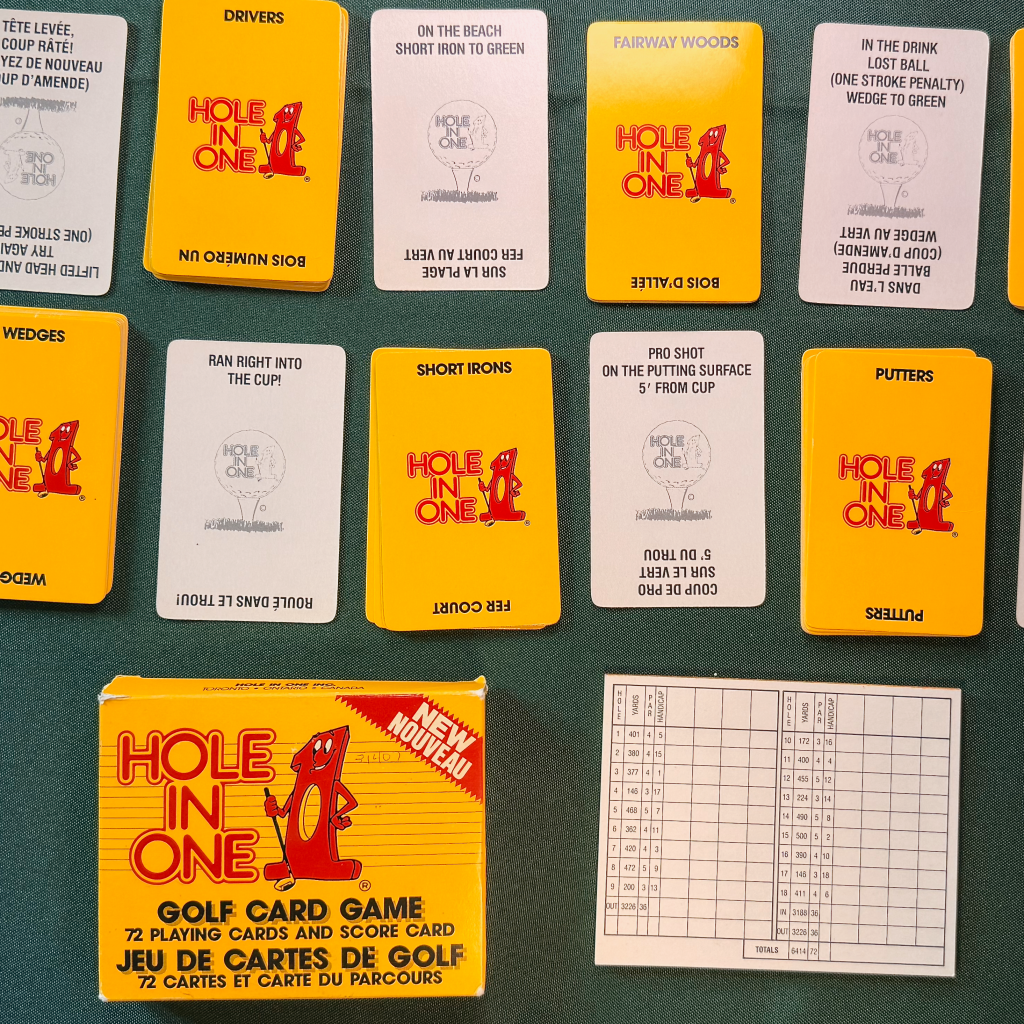
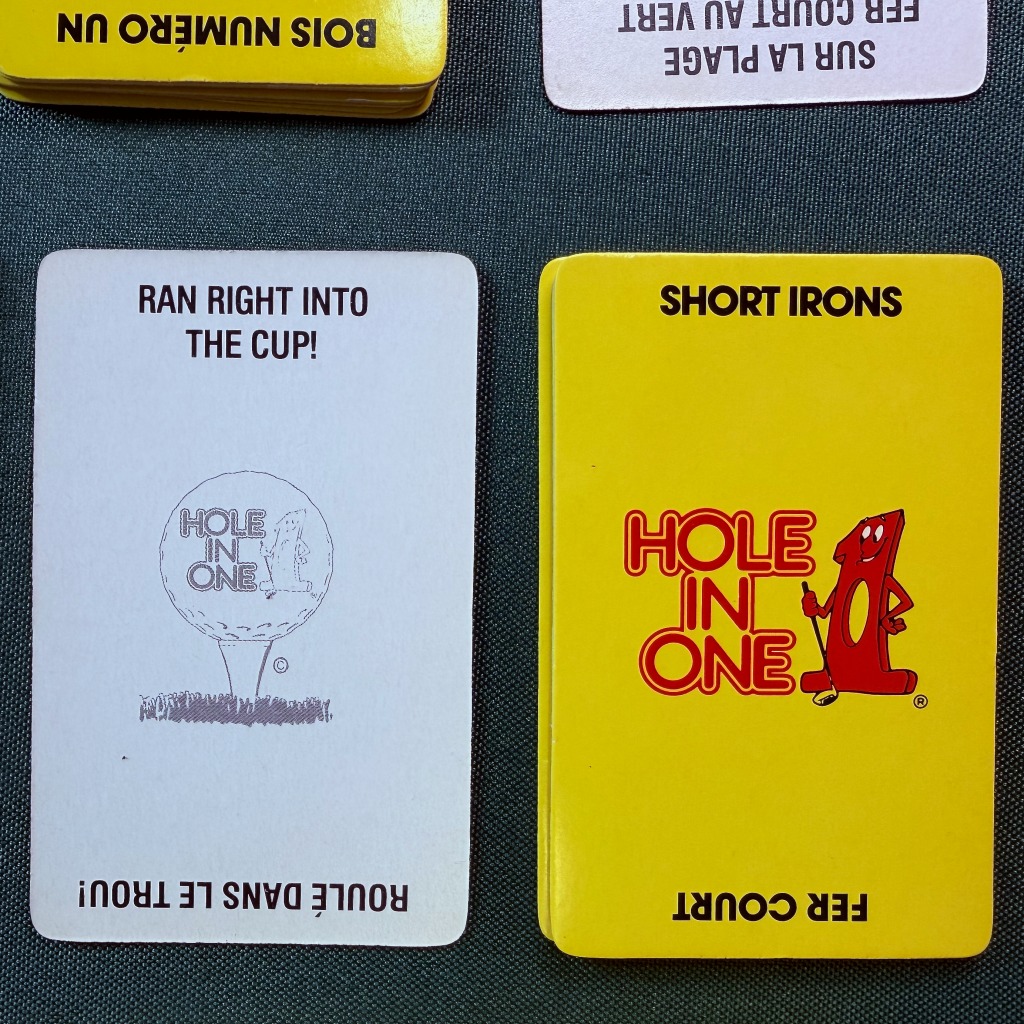
You separate the 72 cards into six decks by club type: Driver, Wood, Long Iron, Short Iron, Wedge, and Putter. Each card shows the result of your shot — how many strokes it took and which club to use next. You tee off with the Driver on par 4s and 5s, or a Short Iron on par 3s, and play through the sequence until you hole out.
The rules enforce a strict club progression. All Driver shots must be completed before you move to Woods or Long Irons. All of those must be completed before Short Irons. Short Irons before Wedge. Wedge before Putter. It mirrors how a real hole plays out — you drive, you approach, you chip, you putt.
On the green, the game even follows putting etiquette. Fringe putts go first, then farthest from the cup. All putters putt out before the next opponent plays. That’s straight out of the Rules of Golf.
After each hole, cards are reshuffled. The high scorer shuffles. The low scorer tees off first. You play 9 holes, then replay them for a full 18. One to four players.
A Simulation, Not a Card Game
What makes Hole in One unique in this series is that it’s really a golf simulation that happens to use cards. There are no hand management decisions. No hidden cards. No strategic swaps. You’re not playing against the cards — you’re playing through them. Each card tells you what happened and what to do next. The randomness comes from the shuffle, not from player choice.
That makes it closer to the Pocket-Size Golf Card Game from the 1950s than to the draw-and-swap games like Rain ‘r Shine or Two Under. It’s a fundamentally different design philosophy: the card game doesn’t represent golf — it is golf, just dealt out of a deck instead of played on a course.
For some players, that’s exactly what they want. No learning curve, no strategy to master, just shuffle and play through a round. For others, the lack of player agency might feel more like watching golf than playing it. Both reactions are valid — it depends on what you’re looking for at the table.
The Canadian Context
Canada’s Official Languages Act requires that consumer products be labeled in both English and French. That’s why the entire back of the Hole in One box is printed in both languages — every rule, every instruction, every line duplicated in French. It’s a uniquely Canadian requirement that gives the packaging a look and feel you won’t find on any American game from this era.
Toronto in 1985 was in the middle of a boom. The Blue Jays won their first American League East title that year. The city hosted the first-ever World Masters Games. The economy was growing, and the Canadian dollar was competitive. It was a good time to launch a product out of Toronto — and the “New / Nouveau” banner on the box suggests Hole in One Inc. was trying to ride that energy.
Golf has deep roots in Canada. The Royal Montreal Golf Club, founded in 1873, is the oldest golf club in North America. The Canadian Open dates back to 1904. And Toronto’s courses — St. George’s, Rosedale, Scarboro — are some of the most storied in the country. A golf card game coming out of Toronto in 1985 makes perfect sense.
Finding One Today
Hole in One surfaces on eBay and Etsy with some regularity — more so than most games in this series. Complete copies with all 72 cards and the score pad tend to run in the $10–$20 range. The yellow box is distinctive enough that you’ll recognize it immediately. If you grew up near the Canadian border in the 1980s, you might recognize it from memory.
Across the Bridge
This series has taken us from Lafayette, Indiana to Racine, Wisconsin to Toano, Virginia to Grafton, North Dakota. This is the first stop across the border — and it won’t be the last. The love of golf card games doesn’t stop at the 49th parallel.
For me, finding Hole in One was personal. Growing up in Buffalo, Canada wasn’t far away — it was right there. I saw this game as a kid, I didn’t know then that decades later I’d be building a vintage golf card game collection and writing about every one I found. I definitely didn’t know I’d invent my own.
Golf the Card Game takes a completely different approach — it’s a strategy game with the Fore! Card, Wild Cards, and the Mulligan mechanic, where every decision matters. Hole in One is a pure simulation where the cards do the deciding for you. Different games for different moods. But both come from the same place: a love of golf that outlasts the season.
Got a copy of Hole in One? Know anything about Hole in One Inc. or Active Communications out of Toronto? Reach out at playgtcg.com or find us on social media.
This post is part of our ongoing series exploring vintage golf card games throughout history. From American basements to Canadian tuck boxes, the love of golf at the table has never faded — in any language.