“Golf The Year Round – Rain or Shine” That’s the promise on Par-It’s faded gold and maroon box and the typewriter printed golf card game rules . No year listed. No company name. Just a typewritten instruction sheet and 96 cardboard cards that capture golf’s cruelest truth: you can pick the right club and still end up out of bounds.
How to Play Golf Card Game: Par-It’s Distance System
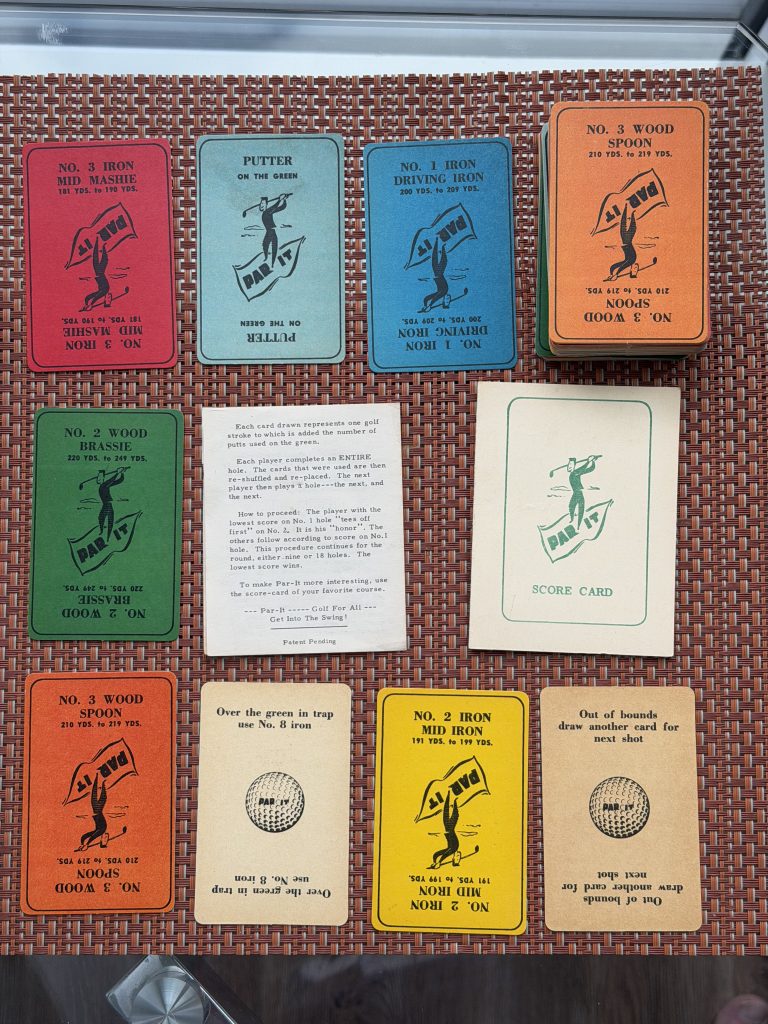
What’s in the box:
- 96 cards organized into 12 stacks (8 cards per club)
- 8 colors representing different clubs (red = No. 3 Iron, etc.)
- Typewritten golf card game rules.
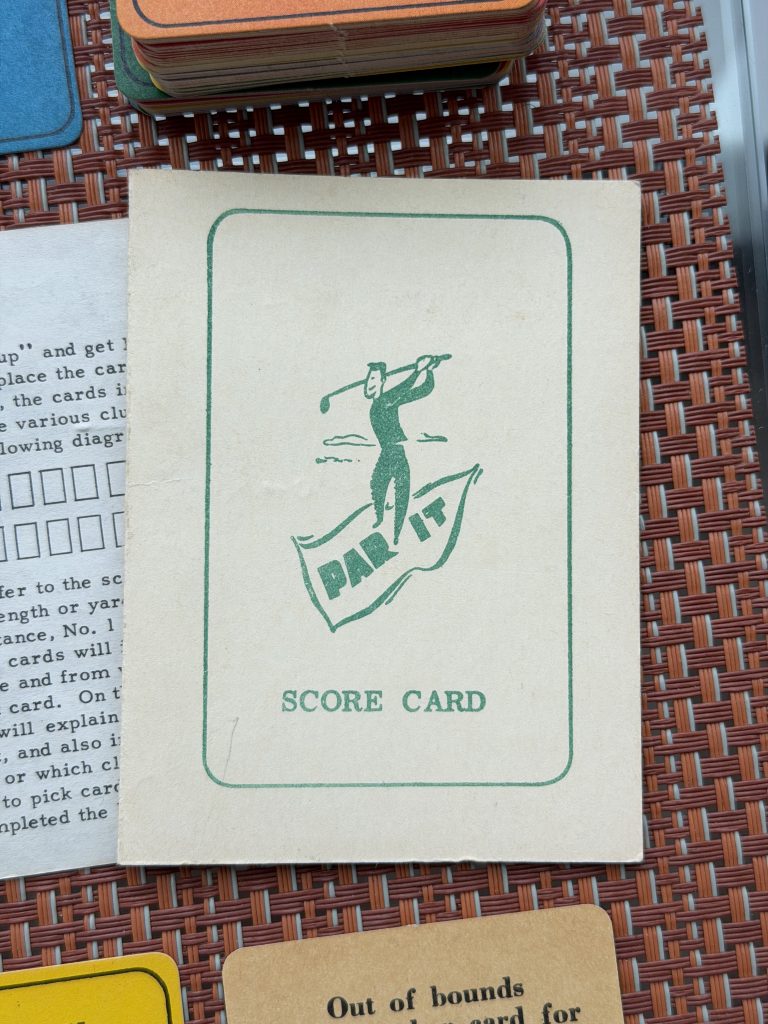
- Vertical scorecard (use your favorite real course!)
Here’s the brilliance: Front of card shows your club. Back reveals your fate.
You check the hole yardage (say, 187 yards). Pick the appropriate club stack. Flip the card. Maybe it says “20 yard advance.” Maybe “out of bounds.” You’re at the mercy of the golf gods.
Each card drawn = one stroke. You keep picking clubs based on distance remaining until you putt out. Then reshuffle for the next player.
What Makes Par-It Genius (And Frustrating)
This captures real golf’s gambling nature better than any vintage golf card game I’ve found.
In real golf, you can stripe a perfect 7-iron and still find water. Par-It nails this. You’re making strategic club choices based on yardage, but the outcome? That’s between you and the deck.
The “honor” system is pure golf: Lowest score on the previous hole tees off first on the next. Someone thought about authenticity here.
The scorecard touch: Instructions say “use the score-card of your favorite course.” Imagine playing Pebble Beach or Augusta in your living room in the 1970s. That’s marketing gold they never capitalized on.
Why Vintage Golf Card Games Like This Vanished
Par-It had clever mechanics but fatal flaws:
What worked:
- Distance-based club selection (real golf decisions)
- Uncertainty in every shot (real golf tension)
- Plays fast (complete a hole, move on)
- “Honor” system adds competition
What killed it:
- Thin cardboard cards (wore out fast)
- No company backing (typewritten rules scream “garage operation”)
- Too much randomness (less strategy than Pokolf)
- Zero brand presence (who even made this?)
Most family golf card games from this era couldn’t survive distribution problems. One print run, then estate sale boxes.
What Par-It Taught Me About GTCG
Golf needs both strategy AND uncertainty.
Par-It leaned too heavy on luck. Pokolf leaned too heavy on strategy. The best golf card games balance both—you make smart decisions, but you’re never 100% safe.
Golf the Card Game keeps Par-It’s “anything can happen” tension while adding strategic depth. You’re not just flipping cards and hoping. You’re managing your round.
Also? That vertical scorecard matters. Tracking your round on authentic golf paper makes it feel real. GTCG kept that.
The Verdict
Par-It Golf Card Game is fascinating archaeology. Someone understood golf’s emotional core—the hope, the surprise, the agony—and put it in 96 cards. They forgot a Mulligan, which GTCG learned from and added.
Would I play it today? For the nostalgia, yes.
Would I recommend hunting golf card games for sale to find a copy? Only if you collect game history like I do. Check out this post about Pokolf for another almost made card game.
Want the spirit of Par-It with better gameplay? That’s why GTCG exists.
Shop GTCG | See the Full Collection
What’s your tolerance for luck vs. strategy in games? Drop a comment.
Pingback: Let’s Play Golf (1969) Classic Golf Card Game -
Pingback: The Secrets Behind the Golf Card Game Pokolf - Golf the Card Game