Tee-Time Poker Playing Cards: The Game You Played While Playing Golf
Every other game in this series asks the same question: how do you bring golf to the kitchen table? This one flips it. Tee-Time Poker Playing Cards asked: what if the card game was the golf course?
Tee-Time Poker Playing Cards by Ultimate Golf Inc. is designed to be played during your actual round of golf. You earn cards based on how you play each hole, and by the end of 9 or 18 holes, you’ve assembled a poker hand. Best hand wins. Your golf game and your card game happen simultaneously.
I’ve never seen anything quite like it and apparently, neither has the internet — because this game is virtually invisible online. No BoardGameGeek entry, No eBay listings, No company history for Ultimate Golf Inc. I found this deck still shrink-wrapped, no box, just the cards and four instruction cards tucked inside. A true ghost in the world of golf gaming.
The Deck
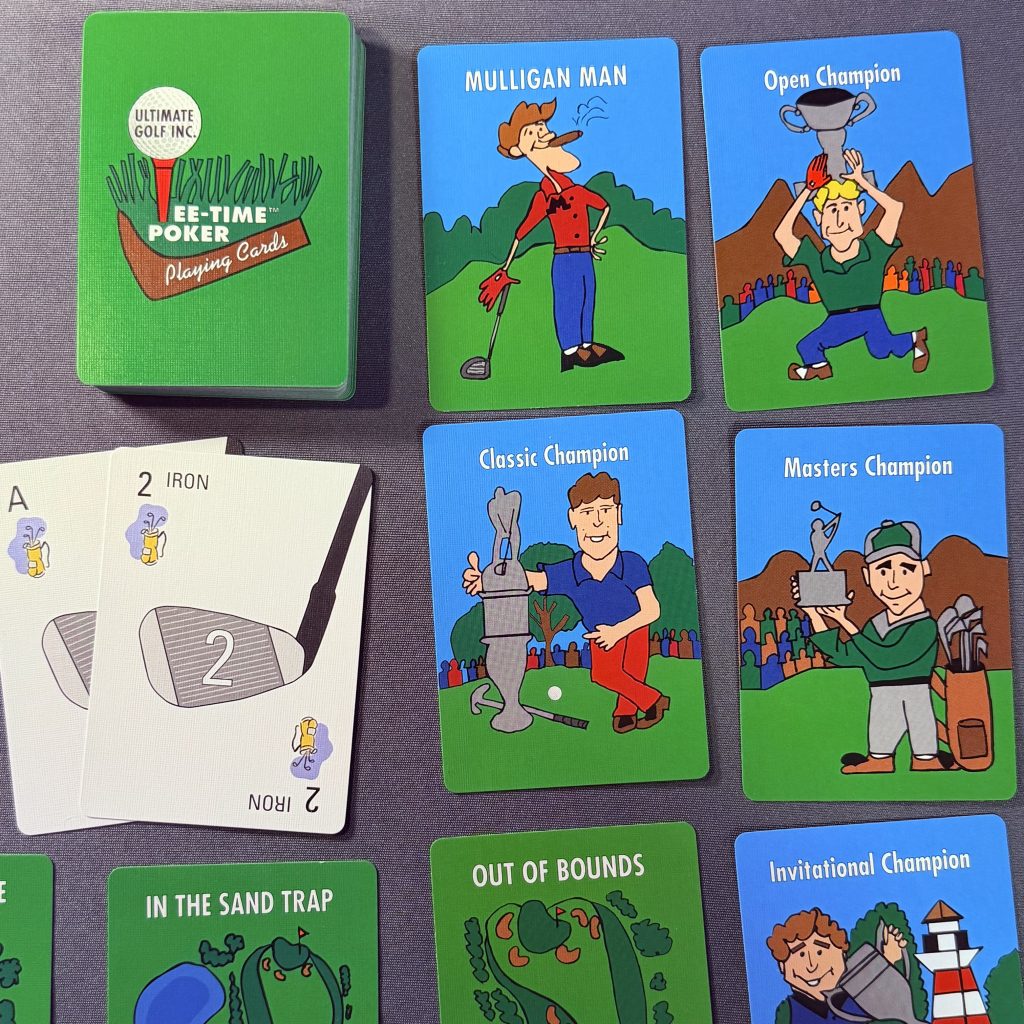
The Tee-Time deck has 52 cards, but it’s not a standard deck — everything is golf-themed from the ground up, but instead of Hearts, Diamonds, Clubs, and Spades, you get four golf suits: Golf Balls, Golf Carts, Golf Bags, and Golf Greens. Instead of numbered cards, you get Irons — 1 Iron through 10 Iron, across all four suits, for 40 cards total. The 1 Iron plays like an Ace (high or low).
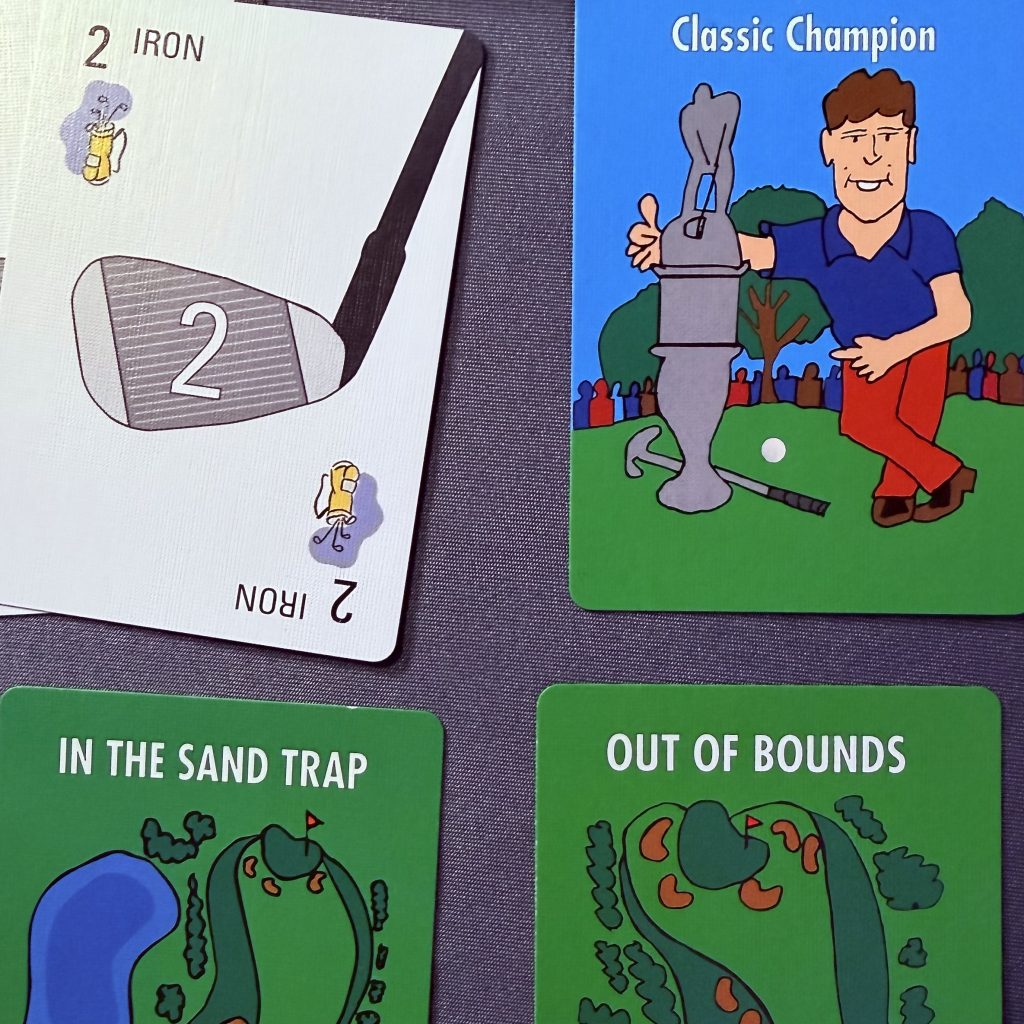
Then it gets interesting, with the remaining 12 cards are specialty cards that add chaos and strategy: 4 Hazard Cards (Sand Trap and Deep Rough) that are dead weight in your hand, 2 Penalty Draw Cards (Lost Ball in the Lake and Out of Bounds) that penalize you on the next hole, 4 Tee-Time Tournament Champion Cards (The Tee-Time Open, Masters, Classic, and Invitational) that serve as wild cards, and 2 Mulligan Man Cards that let you draw an extra card from the deck.
It’s a poker deck rebuilt for golfers, with cards that actually mean something to anyone who’s ever found a bunker or dunked one in the lake.
How It Worked: Golf Course Rules vs. Clubhouse Rules
This is the real innovation. Tee-Time Poker offered two completely different ways to play — one on the course, one after the round.
Golf Course Rules meant you carried the deck with you on the course (in the box, in the cart). As you played each hole, you earned cards from the deck based on your score. Better scores earned more cards. By the end of the round, you’d assembled a poker hand from the cards you’d earned over 9 or 18 holes.
Clubhouse Rules meant you played your round first, then sat down at the 19th hole with your scorecard and the deck. You’d go through the card hole by hole, dealing cards to each player based on what they’d earned. Same result, different setting — and probably more beer involved.
Either way, your golf performance built your poker hand. The better you played, the more cards you drew. The more cards you drew, the better your shot at a winning hand.
Three Games in One Deck
The instructions offered three distinct on-course formats, each borrowing from classic golf betting culture:
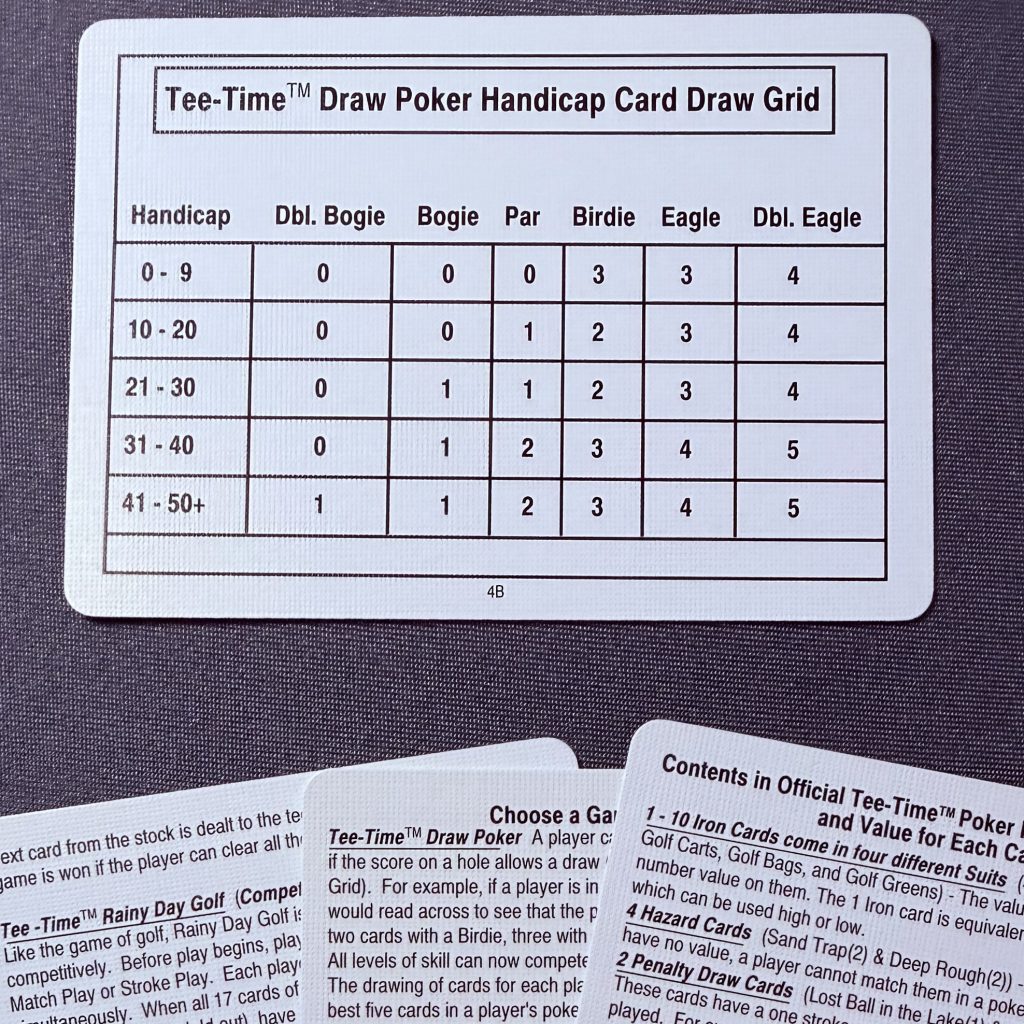
Tee-Time Draw Poker was the flagship mode. A handicap grid determined how many cards you could draw based on your score and your handicap bracket. A 10-20 handicap player drew one card for a par, two for a birdie, three for an eagle. A scratch golfer? Zero cards for par — you had to beat it to earn anything. This leveled the playing field brilliantly. A 40-handicap could out-draw a scratch player and build a better poker hand, even while shooting higher scores.
Tee-Time Skins Game Poker played like a traditional skins game, but instead of money, you earned cards. Win the hole, draw a card. Progressive stakes meant later holes were worth more cards. Carryovers made tied holes pile up. It merged the skins format that every golfer already knew with a poker payoff at the end.
Tee-Time Match Play awarded a card to the hole winner, with both players drawing on ties. Simple, clean, and it worked for teams too.
On top of those, you could layer in bonus draws for greenies on par 3s, sandies (getting out of a trap and making par), birdies, and eagles. If you’ve ever played in a group that runs nassaus, skins, and junk bets simultaneously, this is that energy — channeled into a card game.
The Poker Hands
The hand rankings follow standard poker — one pair, two pair, three of a kind, straight, flush, full house, four of a kind, straight flush — with two additions. Five of a Kind became possible thanks to the wild cards. And at the very top sat the Major Match: all four Tee-Time Tournament Champion Cards in one hand. That was the unbeatable hand — the equivalent of holding all four major trophies at once.
At Home, Too
The instructions didn’t stop at the golf course. There’s an entire section for at-home poker nights using the Tee-Time deck. Five Card Draw, Seven Card Stud, a solitaire game called Rainy Day Golf, a bluffing game called Night Golf where you can’t look at your cards, Clubhouse Poker (lowest hand wins), Mulligan Man Poker (pair of Mulligan Men auto-wins), and Tee-Time Rummy. Someone put serious thought into making this deck versatile enough to live on your shelf year-round.
The Mystery of Ultimate Golf Inc.
Here’s what I don’t know — and I’ve looked. I can’t find anything about Ultimate Golf Inc. No website, no trademark records that jump out, no interviews, no advertisements. The cards are high quality, the instructions are incredibly detailed (four cards’ worth of rules), and the game design shows someone who deeply understood both golf betting culture and poker. This wasn’t thrown together. Someone invested real time, real thought, and real money into manufacturing a custom deck.
And then it vanished. No trace online. Just shrink-wrapped decks that surface occasionally in the wild, waiting for someone to find them.
Why This One Matters
Most golf card games — including mine — are designed to replace a round of golf when you can’t get to the course. Tee-Time Poker did the opposite. It enhanced the round you were already playing. It turned your Tuesday afternoon foursome into a poker tournament without adding a single extra minute to your round. Your golf was the card game.
That’s a completely different design philosophy, and it’s one that deserves recognition. The handicap grid alone is a piece of game design that most modern designers would be proud of — a simple system that let scratch golfers and weekend hackers compete in the same poker game on equal footing.
Golf the Card Game lives in a different space — it’s a standalone game built for the kitchen table, game night, or anywhere you want to play without a tee time. But I have deep respect for what Ultimate Golf Inc. tried to do. They didn’t simulate golf with cards. They merged cards with golf. It’s a fundamentally different idea, and it’s one I haven’t seen anyone else pull off this well.
If you know anything about Ultimate Golf Inc. or the people behind Tee-Time Poker, I’d love to hear from you. This is one of the most thoughtfully designed games in this entire series, and the creators deserve to be found. Checkout Pokolf or The 19th Hole Classic for more. Reach out at playgtcg.com or find us on social media.
This post is part of our ongoing series exploring vintage golf card games throughout history. From kitchen table games to on-course poker decks, the love of golf at the table — or in the cart — has never faded.