Top Golf Classic Golf Playing Cards (1986): The Maverick of Golf Card Games
1986. Tom Cruise is doing barrel rolls in an F-14. “Danger Zone” is on every radio in America. Top Gun is the number one movie in the country. And in Whittier, California — a quiet suburb 20 miles from downtown Los Angeles — somebody releases a golf card game called Top Golf Classic Golf Playing Cards.
Coincidence? Almost certainly. But in a series full of games that take themselves seriously, there’s something perfect about a stripped-down, no-frills golf card game arriving in the same year as the most over-the-top movie of the decade.
The Box
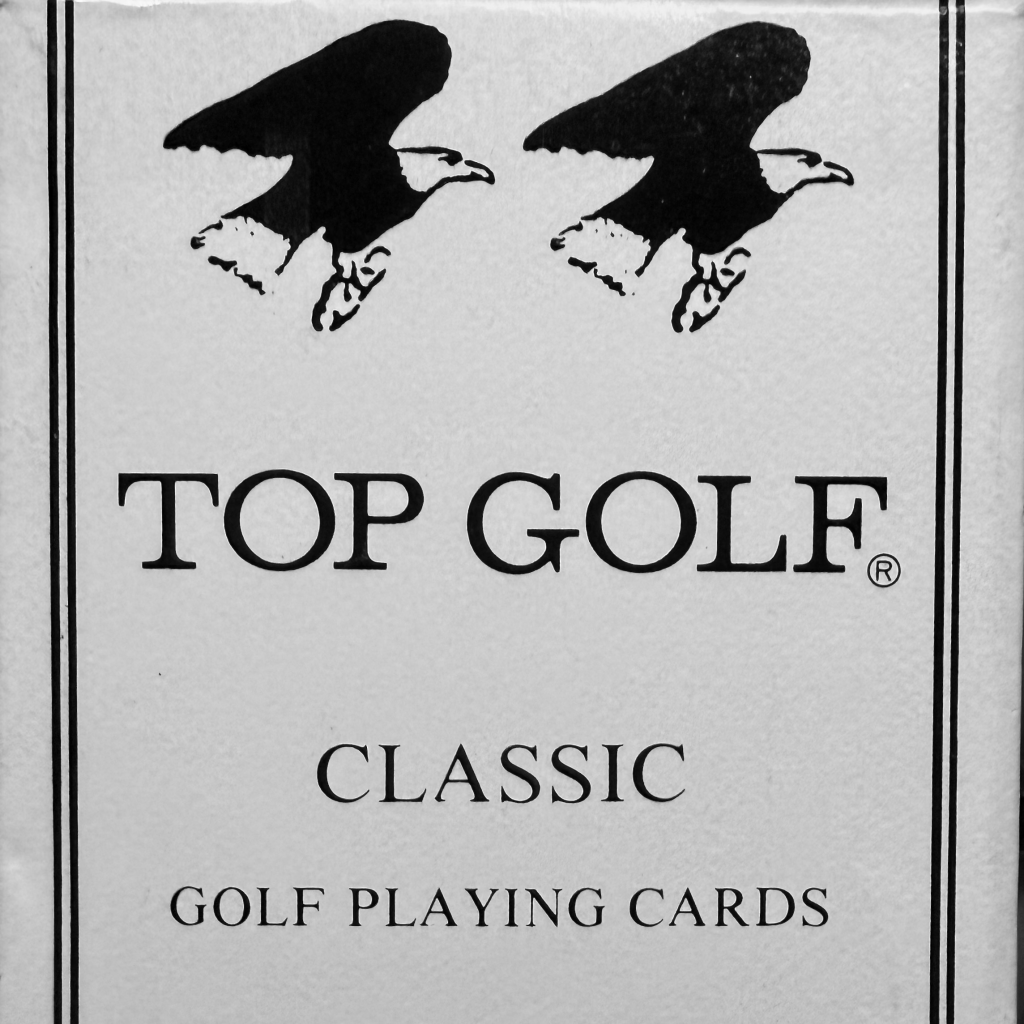
Top Golf Classic comes in a black-and-white tuck box — two eagles on the front, a golf ball on the back. Very plain. No flash, no color photos, no marketing copy beyond the essentials. One side reads “Players Choice. The Skins Game.” The other: “Copyright 1986 Top Golf Playing Card Co. Whittier, CA 90605.”
Inside: 48 green-and-white playing cards with black-and-white backs, and 2 instruction cards. That’s it. No score pad, no tokens, no extras. Just the deck and the rules.
The no-frills presentation matches the game itself — this is a golfer’s game, designed for people who already speak the language. No hand-holding. No tutorials. You either get it or you don’t.
How It Played: Golf Wild
Top Golf Classic uses a format called “Golf Wild” — and it’s unlike anything else in this series. The dealer names the par and the yardage for each hole. Players are dealt cards equal to par. From there, you’re trying to piece together a hand that adds up to exactly the yardage the dealer selected, plus a Putt card or Wild card to finish the hole.
Let’s say the dealer calls a Par 4, 400 yards. You get 4 cards and if your yardage cards add up to exactly 400 and you have a Putt card, you’ve made par — your score is 4 (the number of cards in your hand). If you can do it in fewer cards, you’re under par. If your cards don’t add up, you discard and draw replacements — but every card counts toward your score, even the dead weight.
That’s the tension. You get one chance to discard at the start. After that, every card dealt to you sticks. You might draw cards that can’t help you, but they still count. The game punishes indecision and rewards a clean initial read of your hand.
The Dual Value Cards
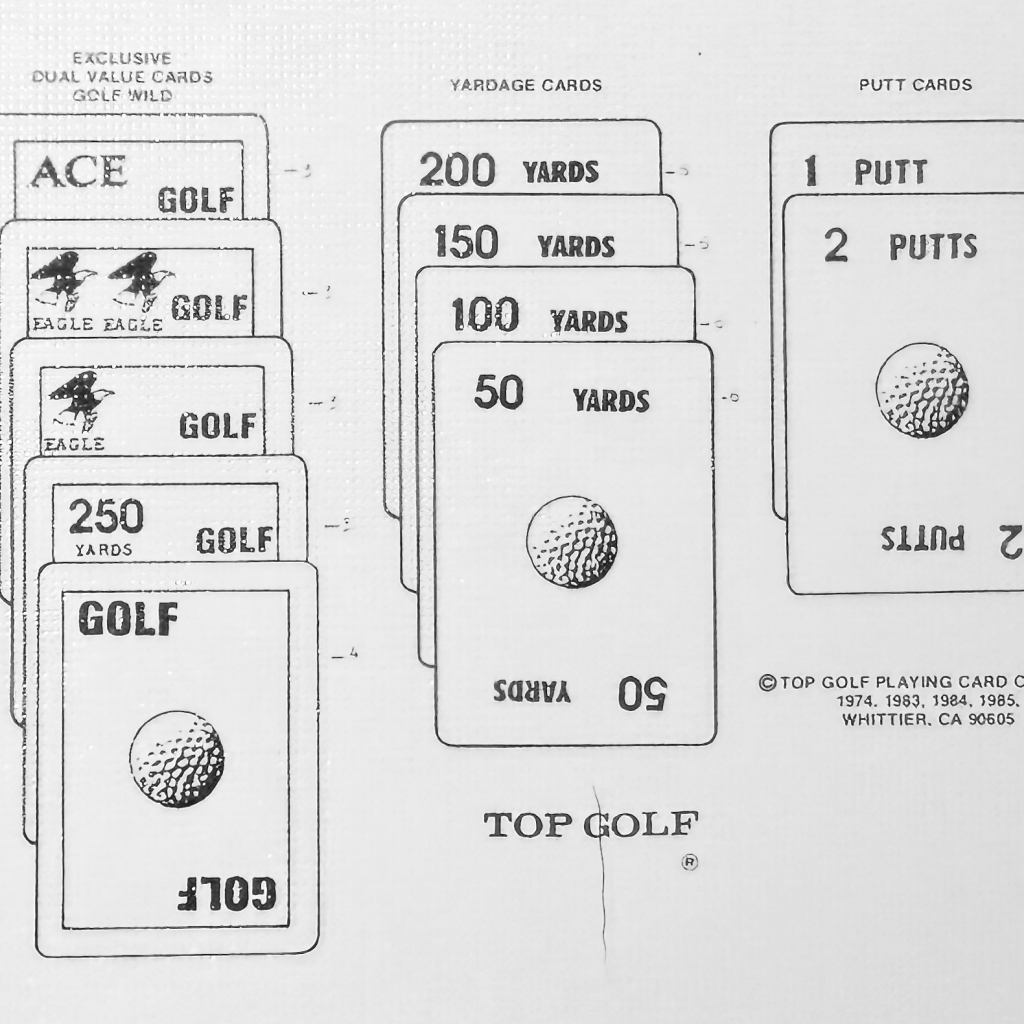
The deck has 48 cards broken into yardage cards (200, 150, 100, 50 yards), putt cards (1 Putt and 2 Putts), and 12 dual value cards that are the heart of the game. Three Ace-Golf cards can make a hole-in-one on a par 3. Three Double Eagle-Golf cards. Three Eagle-Golf cards. Three 250-yard cards. Any of these can be played at face value or used as a Wild card — substituting for any Putt or Yardage card you need.
That “players choice” flexibility is what makes Golf Wild work. You’re not just dealt a hand — you’re reading it, finding the combinations, and deciding how to play your dual value cards. Use the Eagle as an Eagle (two under par)? Or burn it as a Wild to fill a yardage gap? Those are real decisions.
The Skins Game Connection
The side of the box reads “Players Choice. The Skins Game.” That’s not just a subtitle — it’s a timestamp. The televised Skins Game launched in 1983 with Jack Nicklaus, Arnold Palmer, Gary Player, and Tom Watson, and by 1986 it was one of the biggest events in golf entertainment. The format — each hole worth money, tied holes carrying over — was electric. It made golf feel like gambling, which made it feel dangerous, which made it feel cool.
Top Golf Playing Card Co. was clearly riding that wave. The Skins Game was the hottest format in golf, and putting it on the box was a marketing signal: this isn’t your dad’s card game. This is the version where something’s on the line every hole.
Whittier, California: A Golf Town
Whittier sits at the foot of the Puente Hills in Los Angeles County — tree-lined streets, quiet neighborhoods, and a surprising density of golf courses for a city of 87,000. The California Country Club, designed by William Bell Jr. (who also designed Torrey Pines), has been there since 1956. Candlewood Country Club sits on Telegraph Road. Whittier Narrows is just down the road. The Hacienda Golf Club, one of the oldest and most storied courses in Southern California, was founded nearby in 1920 by oil baron Alphonso Bell, who made his fortune in the Whittier area.
A golf card game coming out of Whittier in 1986 makes sense. This was a town where golf was part of the landscape — Southern California year-round golf weather, multiple courses within a short drive, and a culture that lived and breathed the game.
The Mystery (Again)
Top Golf Playing Card Co. is another ghost. No website, no company history, no interviews. The copyright line on the instruction card is interesting though: “© Top Golf Playing Card Co. 1986. 1974, 1983, 1984, 1985.” Those earlier dates suggest the game — or some version of it — existed for over a decade before the 1986 edition was printed. Someone was tinkering with this concept since 1974. That’s 12 years of development from a company that left almost no trace.
Whoever was behind Top Golf Playing Card Co. in Whittier, California, they weren’t weekend hobbyists. The dual value card system, the yardage math, the dealer’s choice format — this is a game designed by someone who played a lot of golf and a lot of cards. The simplicity of the packaging belies the depth of the design.
Finding One Today
Good luck. Top Golf Classic is one of the hardest games to find in this entire series. Listings are rare, and the plain black-and-white box doesn’t exactly scream “collector’s item” at a glance. If you spot one, grab it — especially if the instruction cards are intact, because that’s where the game lives.
The Danger Zone
Every game in this series brings something different to the table. Top Golf Classic’s contribution is the yardage math — the idea that your hand has to add up to an exact number, and every card you touch counts. It’s more poker-meets-golf-math than anything else in the collection. The dealer’s choice on par and yardage means no two holes play the same way.
Golf the Card Game takes a completely different path — it’s a strategy game with the Fore! Card, Wild Cards, and the Mulligan, where decisions drive outcomes rather than yardage math. But I respect what Top Golf Classic attempted. In a world of draw-and-swap games, they built something that required you to think like a golfer — to know your distances, manage your clubs, and make the math work under pressure.
If you know anything about Top Golf Playing Card Co. of Whittier, California, reach out. We’re building a map of golf card game history, and there’s a blank spot at 90605 that needs filling. Find us at playgtcg.com or on social media.
This post is part of our ongoing series exploring vintage golf card games throughout history. From SoCal tuck boxes to frozen North Dakota P.O. Boxes, the love of golf at the table has never faded.