
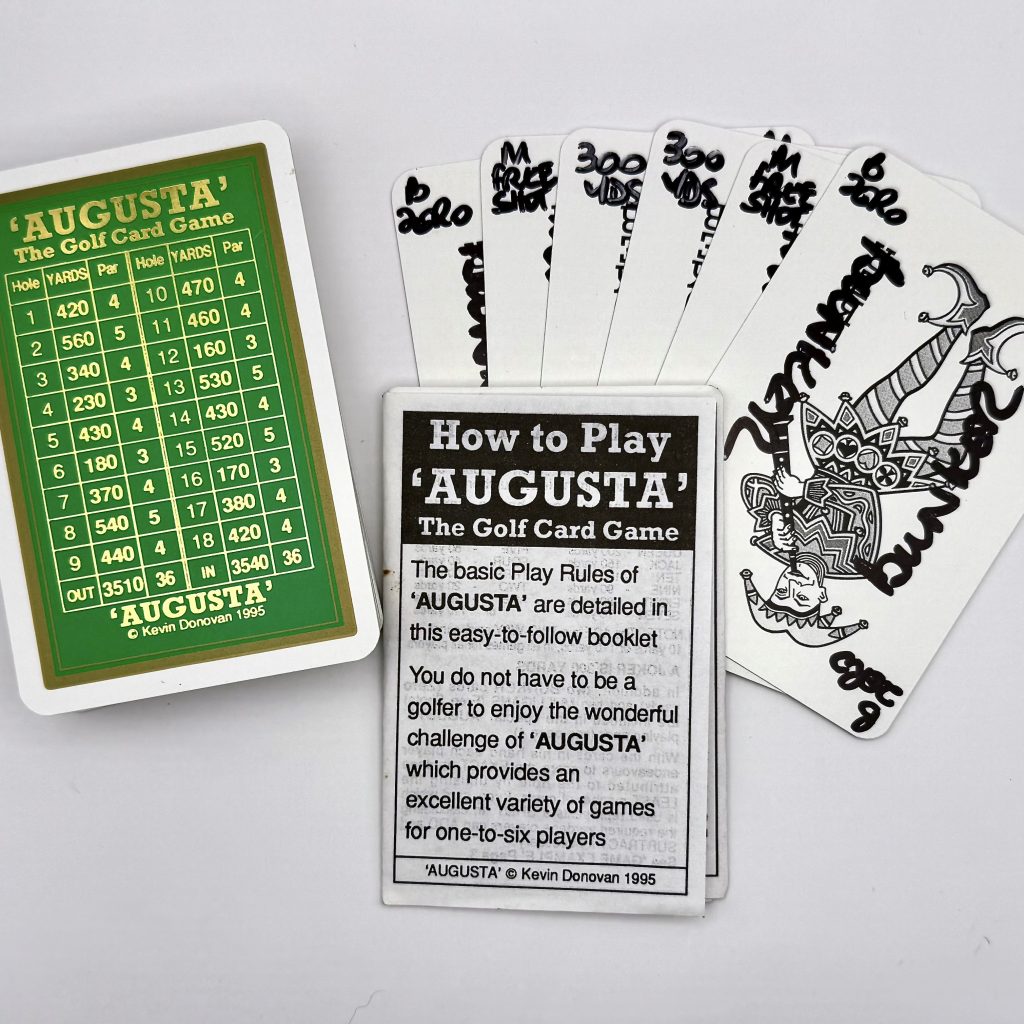
Most of the games in my collection arrived in shrink-wrap. This one arrived in a scuffed plastic case with two words scrawled across the top in black marker: TEST PACK.
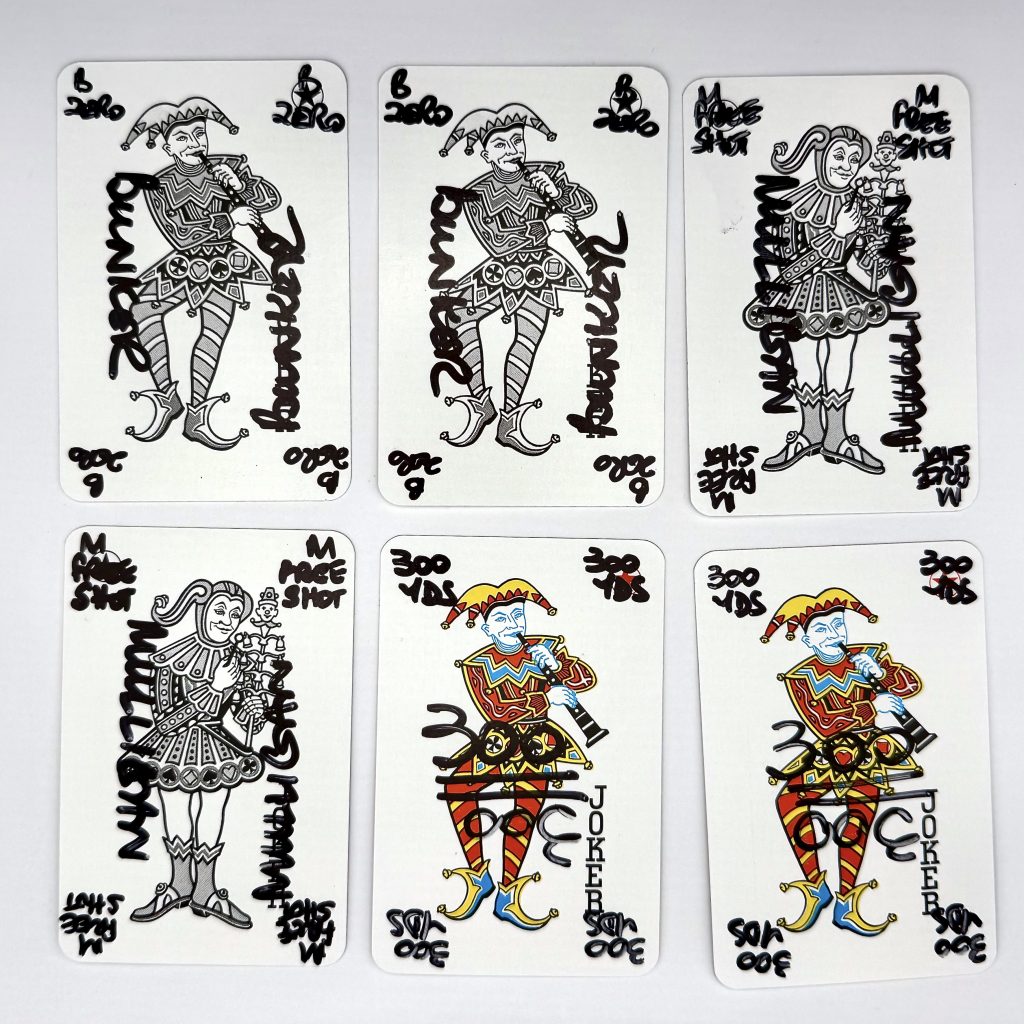
Open it up and the story gets better. Some of the cards are ordinary Jokers that someone has drawn all over by hand — one turned into a 300-yard shot, others relabeled “B — ZERO” for a bunker and “M — FREE SHOT” for a mulligan. This isn’t a factory product. It’s a prototype. A designer sat at a table, took a deck, and invented a golf game one Sharpie stroke at a time.
I know that table. That’s exactly how Golf the Card Game started for me — a regular deck, a marker, and an idea I couldn’t leave alone. So when I tell you this little game called Augusta is one of my favorites to have unearthed, understand that I’m a bit biased. It’s a mirror.
Who Made It?
The rulebook answers plainly: ‘AUGUSTA’ © Kevin Donovan 1995. The back page even prints a contact address — Fairfield House, Barlaston Old Road, Trentham, Staffordshire, England, with a Tel/Fax number. That detail tells you everything about the era and the operation. This was a one-man cottage game out of the English Midlands, sold direct, the kind of thing you’d order by post after seeing it in a golf-club pro shop. It’s the second British golf card game to land in this collection the hard way — Club Golf, also from 1995, took a London package-forwarder to get across the Atlantic.
I’ll be honest with you: there is almost nothing about Augusta online. No BoardGameGeek entry I could find, no reviews, no scans. Everything I’m telling you here comes from the physical game in my hands — the booklet, the cards, the case — not from some tidy history page. In this corner of collecting, the object is the archive. If Kevin Donovan or anyone who remembers this game is out there, I’d love to hear from you.
What Is Augusta?
Augusta is a golf game built on a single, clever idea: every card is a distance, and your job is to reach each hole’s exact yardage in as few shots as possible.
The values run like this:
- King 250, Queen 200, Jack 150 — your big clubs off the tee.
- Ten 100 down to Two 20, counting by tens — your irons and approach shots.
- Ace = 10 or 110 — a two-way card you can play either short or long.
- Joker = 300 yards — the monster drive.
- Bunker = 0 yards — dead weight in your hand.
- Mulligan = a free shot.
Each hole is printed on the back of the cards, and you’re dealt a hand sized to the hole — five cards for a par 3, six for a par 4, seven for a par 5. The target is a real yardage, say 420 yards for a par 4. Now the math starts.
How It Plays
Here’s the part I love. You don’t just add cards up — you can add and subtract to hit the number, and the fewer cards you use, the better your score. Each card you lay down is one shot.
Say you need 420 yards. A King (250), a Ten (100), a Nine (90) and a Two (20) gets you there in four cards — a four on the hole. But the player next to you finds King (250) plus Queen (200) minus a Two (20) — 430 less 10… no, wait — and suddenly everyone at the table is doing arithmetic out loud, arguing about whether subtracting that bunker-adjacent card is genius or madness. It plays like golf crossed with a numbers puzzle, and it’s sneakily competitive.
Can’t make the exact number from your hand? You’re into the Penalty Zone — a face-up “open card” and a face-down “blind card” you can draw, each costing you a penalty shot until you finish the hole exactly. Really stuck? Declare Out of Bounds, swap your whole hand for a fresh draw, and take a two-shot penalty. The target for a full 18 is a score of 72 — par, naturally — and anything under 76 is a good round.
The Card That Caught My Eye
Of all the hand-marked cards in that test pack, the one I keep coming back to is the Mulligan — a free shot, no penalty, swap it for a better card and move on. Any golfer knows the feeling: the do-over you wish you had.
I find it fascinating because the mulligan is one of the ideas I built into Golf the Card Game too — that little mercy that keeps a bad hole from ruining your night. (If you’re curious how ours works, I broke it down in The Mulligan Explained.) Seeing it hand-lettered onto a Joker in a 1995 prototype was a quiet reminder that good ideas in this genre keep getting rediscovered by people who love the game. Augusta reached for it with a marker. I reached for it three decades later on a pool deck. Same instinct.
The Verdict
As a game, Augusta is smarter than it looks. The exact-yardage rule turns every hole into a small, satisfying puzzle, and the ten different play formats in its companion booklet mean it stretches well from a solo round up to six players. It won’t be for everyone — if mental math at the table isn’t your idea of relaxing, this one will feel like homework. But for the golfer who likes a brain-teaser, it holds up beautifully for something knocked together in a Midlands living room in 1995.
What makes my copy special isn’t the rules, though. It’s the marker. This is the version before the version — the test pack, the proof that someone believed in the idea enough to build it by hand before anyone else had seen it. That’s the part of collecting I can’t get enough of.
Augusta and I ended up in the same place from opposite ends of thirty years: a deck of cards, a marker, and a stubborn belief that golf belongs at the kitchen table. My version became Golf the Card Game — a four-card round with a Mulligan, a Fore! card, and Wild cards of its own. You can find it at playgtcg.com or on Amazon.
This post is part of our ongoing series exploring golf card games across the last century — the famous, the forgotten, and the hand-made. Have one I haven’t seen? Get in touch.