Most golf card games let you play your own round and leave everyone else alone. Card Golf is not one of those games. In this one, you can walk over to your rival’s ball — figuratively, across the table — and drop it straight into a bunker. Or lose it. Or knock it out of bounds. On your turn, instead of hitting a shot, you can hand an opponent a Hazard card and wreck their hole.
I did not expect that from a tidy little blue box out of 1960s London. But that’s the fun of collecting these things: the polite ones are often the most ruthless.
Who Made It?
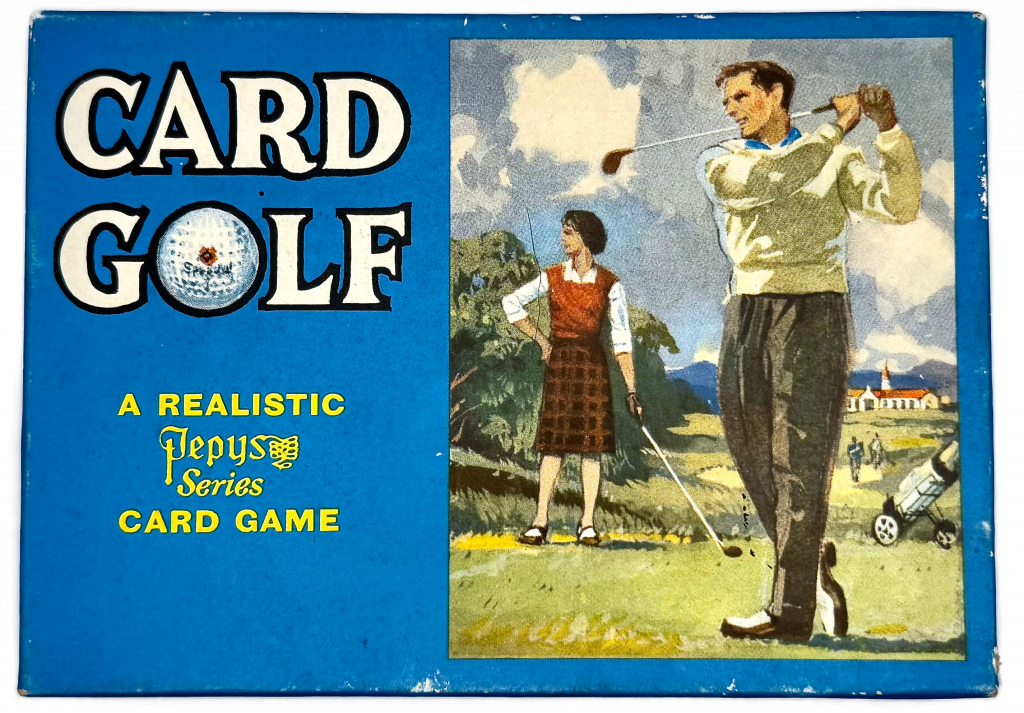
Card Golf is a Pepys game, published by Castell Brothers Ltd. of St. Cross Street, Hatton Garden, London. If you’ve followed this series, you know I like pinning down the exact origin — and here I got lucky. The back of the rulebook prints the publisher’s address plainly, and Peter Berthoud’s excellent Collecting Pepys archive dates the first edition to 1961. The designer and illustrator? “Not credited.” Even the game itself is coy about it — the booklet notes that every swing pictured on the cards is “an accurate reproduction of a swing, but the illustrations do not represent any Golfer, living or dead.”
Here’s the detail that turned this from a game into a small mystery. The box lid announces that Card Golf is the “Successor to Kargo.” Kargo was an earlier Pepys golf card game — the trail points back to the late 1930s — and Card Golf is essentially its 1961 remake: completely redrawn, and bumped from 53 cards to 54. So what I’m holding isn’t a one-off. It’s the second act of a golf card game that Castell Brothers kept alive for more than twenty years. I love that. Somebody at that London firm believed in golf-on-a-table long enough to do it twice.
What Is Card Golf?
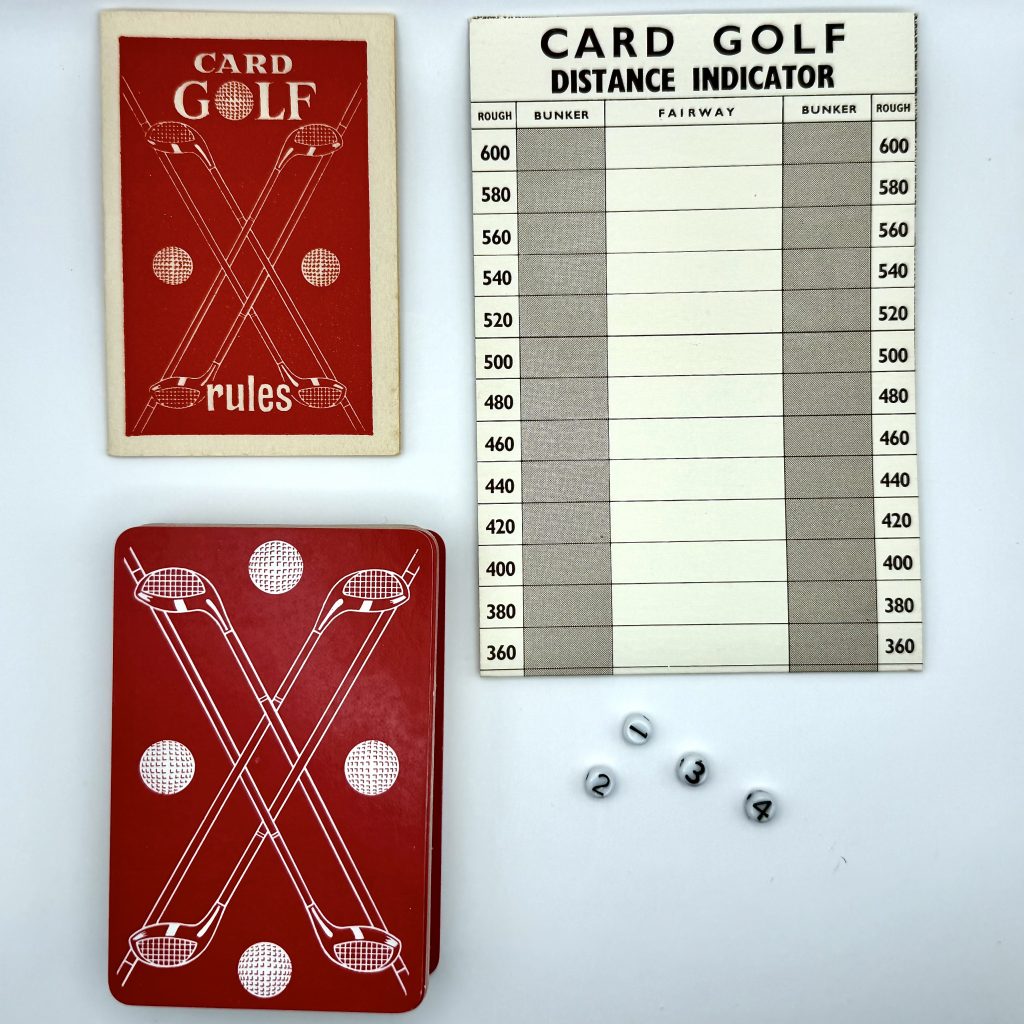
Card Golf is a match-play golf game for 2 to 4 players, and it leans hard into realism. The booklet says it straight: “a knowledge of Golf is not necessary to play this game,” but it’s “based on the Rules of Golf.” The box holds 54 cards, four little numbered “golf balls,” and one clever prop I’ll come back to — a Distance Indicator board.
The 54 cards break down like this:
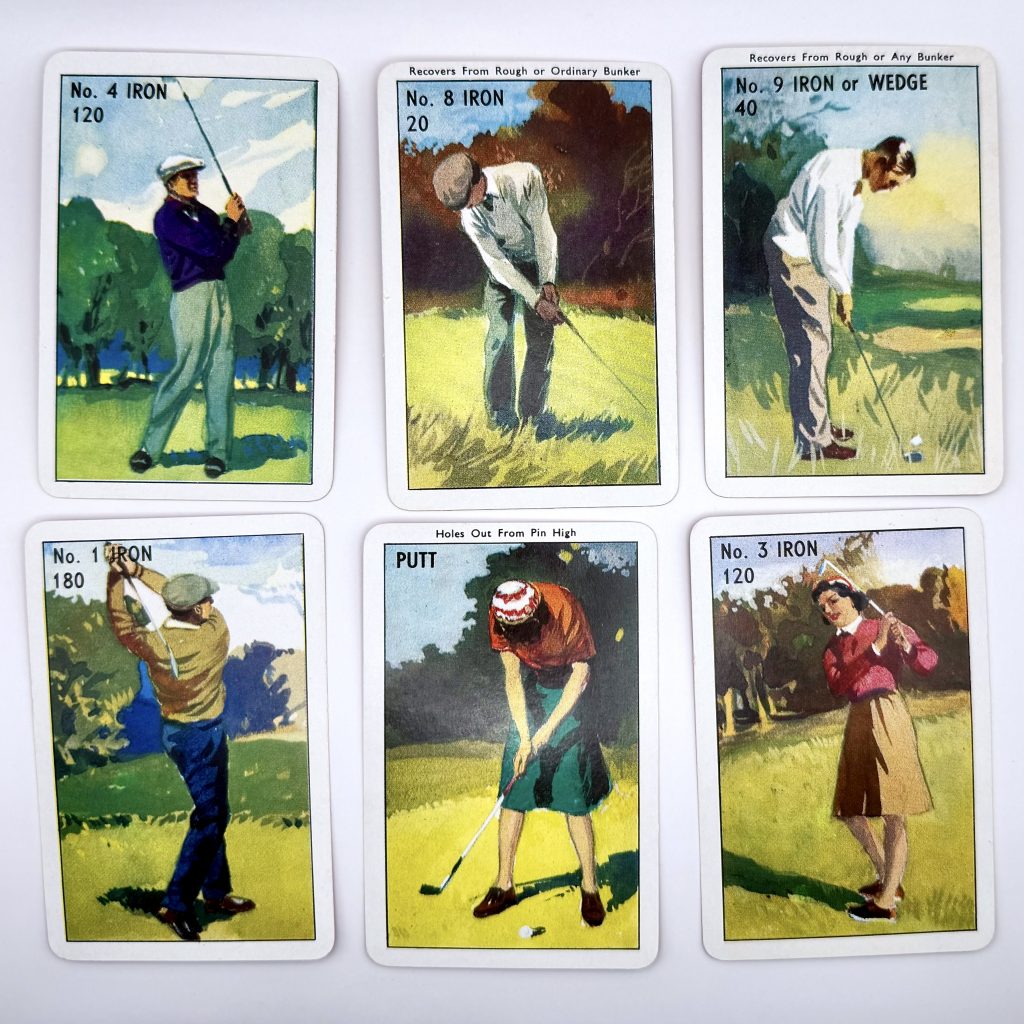
- 29 Distance cards — 13 different clubs, from the driver down to the wedge, each printed with a yardage. Two cards per club, except three Drivers and four No. 9 Irons.
- 12 Putt cards — for work on the green.
- 1 “Holed-Out” card — the single most valuable card in the deck.
- 12 Hazard cards — the mean ones. More on those in a second.
The Distance Indicator — and Playing St. Andrews at Your Kitchen Table
This is the part that made me grin. The Distance Indicator is a printed track marked off in 20-yard steps from 360 up to 600 yards, split into lanes: Rough, Bunker, Fairway, Bunker, Rough. You lay it in the middle of the table, drop your numbered “ball” on the tee, and every stroke card you play moves your ball up the track toward the hole. Land in the Fairway lane and you’re fine. Get shoved into a Bunker or Rough lane and you’ve got trouble.
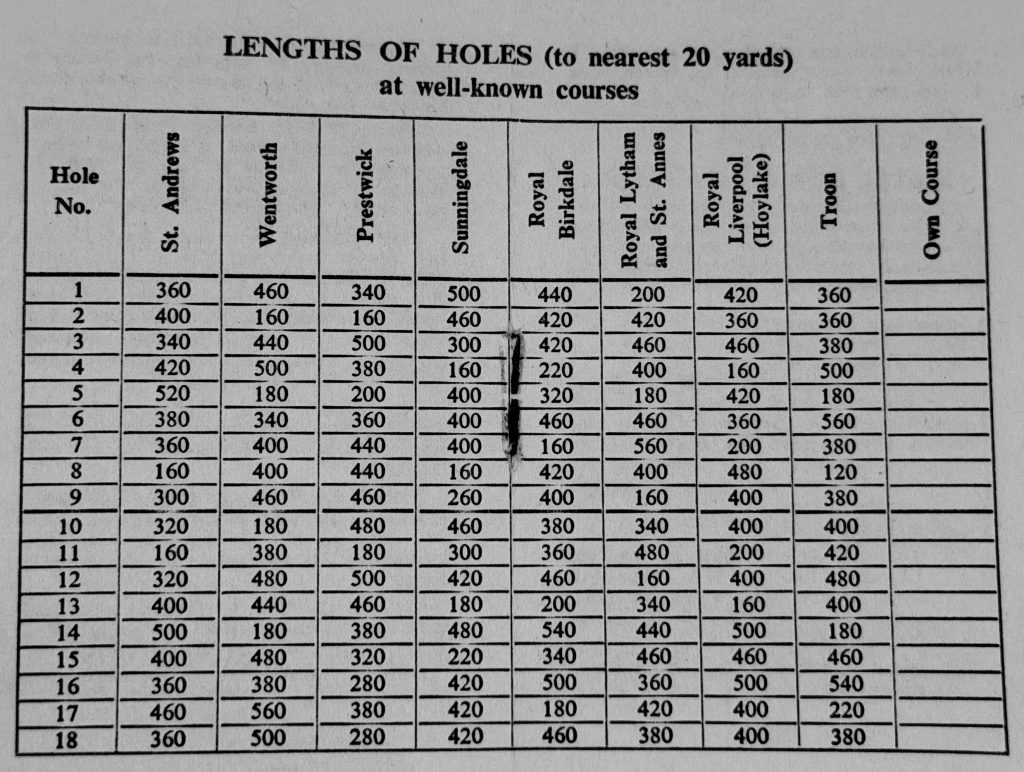
But the genius touch is in the back of the booklet. There’s a table titled “Lengths of Holes at Well-Known Courses,” giving the real yardages — to the nearest 20 yards — for St. Andrews, Wentworth, Prestwick, Sunningdale, Royal Birkdale, Royal Lytham & St. Annes, Royal Liverpool (Hoylake), and Troon.Before you play, you pick a course. Then you play its actual holes, in order, to their actual lengths. Hole 5 at St. Andrews is a 520-yard monster; the 8th is a dinky 160. There’s even a blank column to fill in your own home course.
Think about what that meant in 1961. A family in a flat in London could “play a round at St. Andrews” on a rainy Tuesday, hole by hole, using nothing but a deck of cards and a cardboard track. That blend of a card game with a little board puts Card Golf in interesting company — it reminds me of the card-and-board hybrid I wrote about in Fast Golf (1977), which tried to bridge the same two worlds a decade and an ocean apart.
How It Plays
You’re dealt six cards, with the rest as a draw pile. On your turn you do exactly one of three things: play a Stroke card to advance your ball, play a Hazard card on an opponent, or draw the top card. There’s no discarding, and you’re never forced to play — so a lot of the skill is patience. The booklet actually advises you to hold your distance cards until you’ve got a combination in hand that can reach the green in one clean run, rather than dribbling forward and getting stuck.
Reach the hole’s exact yardage and you’re “Pin-high” — one Putt card and you’re in. The prized Holed-Out card is the only card that lets you finish a hole in a single dramatic stroke from distance, and there’s just one in the whole deck. First shot of every hole has to travel at least 80 yards (no topping it off the tee), and you can’t blow more than 40 yards past the pin. Low score wins the hole; most holes won takes the match. Partners in a four-player game even sit across from each other and share a ball.
The Hazard Cards — Golf’s Politest Form of Sabotage
Now the good part. Instead of taking your own shot, you can hand an opponent one of twelve Hazard cards, and they have to wear it. The lineup is brutal in the most charming, stiff-upper-lip way:
- Lost Ball — cancels their last stroke, sends the ball back, and costs them a turn. The booklet calls it “Losing Stroke and Distance.” Ouch.
- Out of Bounds — exactly as painful as Lost Ball.
- Water Hazard — they miss a turn. One-stroke penalty.
- Bunker — their ball slides into the sand, and their next shot must be a No. 7, 8, or 9 iron.
- Bad Bunker — same idea, but now only a No. 9 iron will get them out.
- Slice and Pull into Rough — ball shoved into the rough (slice sends it right, pull sends it left).
- Missed Putt — the cruelest one: you cancel an opponent’s putt just as they’re about to hole out.
There are rules of etiquette even to the cruelty. You can’t hazard someone who hasn’t left the tee, and — except for a Missed Putt — you can’t touch a player who’s already reached the green. So the sabotage window is real, but bounded. It turns a quiet distance game into something with elbows. That “play it against your opponent” streak isn’t unique to Card Golf, either; I ran into the same idea in the red-bordered chance cards of Club Golf, another British import in this collection — proof that the urge to bunker your friends is a long British tradition.
The Verdict
Card Golf is smarter and nastier than its gentle blue box lets on. The famous-courses table gives it a hook nothing else in my collection has — you’re not playing “a golf game,” you’re playing Troon — and the Hazard cards give it a social, needling energy that keeps four people leaning in. It asks a bit of patience and a bit of scheming, which is a good combination at a table.
What I keep turning over, though, is that “Successor to Kargo” line on the lid. This was a golf card game good enough to be worth rebuilding — redrawn card by card and sent back out into the world in 1961, decades after its first swing. In a genre where most titles get one shot and vanish, that’s rare. The object really is the archive here, and this one tells you people have been trying to fit a round of golf into a deck of cards for the better part of a century.
Card Golf reaches for realism — real courses, real yardages, a track to walk your ball down. I went the other way with Golf the Card Game: a fast four-card round with a Mulligan, a Fore! card, and Wild cards, built to play in minutes with no board and no booklet. Different answers to the same hundred-year-old question. You can find mine at playgtcg.com or on Amazon.
This post is part of our ongoing series exploring golf card games across the last century — the famous, the forgotten, and the imported. Own a Pepys game or remember Kargo? Get in touch.