
Card Golf (2006): The Golf Card Game With No Course of Its Own — You Bring Augusta National
Almost every golf card game I’ve catalogued builds its own little world — printed holes, a fold-out board, hazards drawn onto the cards. The Original Card Golf (Collaboration Reverberation, Inc., 2006) does the opposite. It ships with no holes at all. Instead, it hands you a deck of golf clubs and tells you to go get a real scorecard — your home course, Pebble Beach, Augusta National, whatever you can find — and play that.
That’s the whole trick, and I think it’s a small stroke of genius. The game doesn’t simulate a golf course. It borrows one. Any one. Forever.
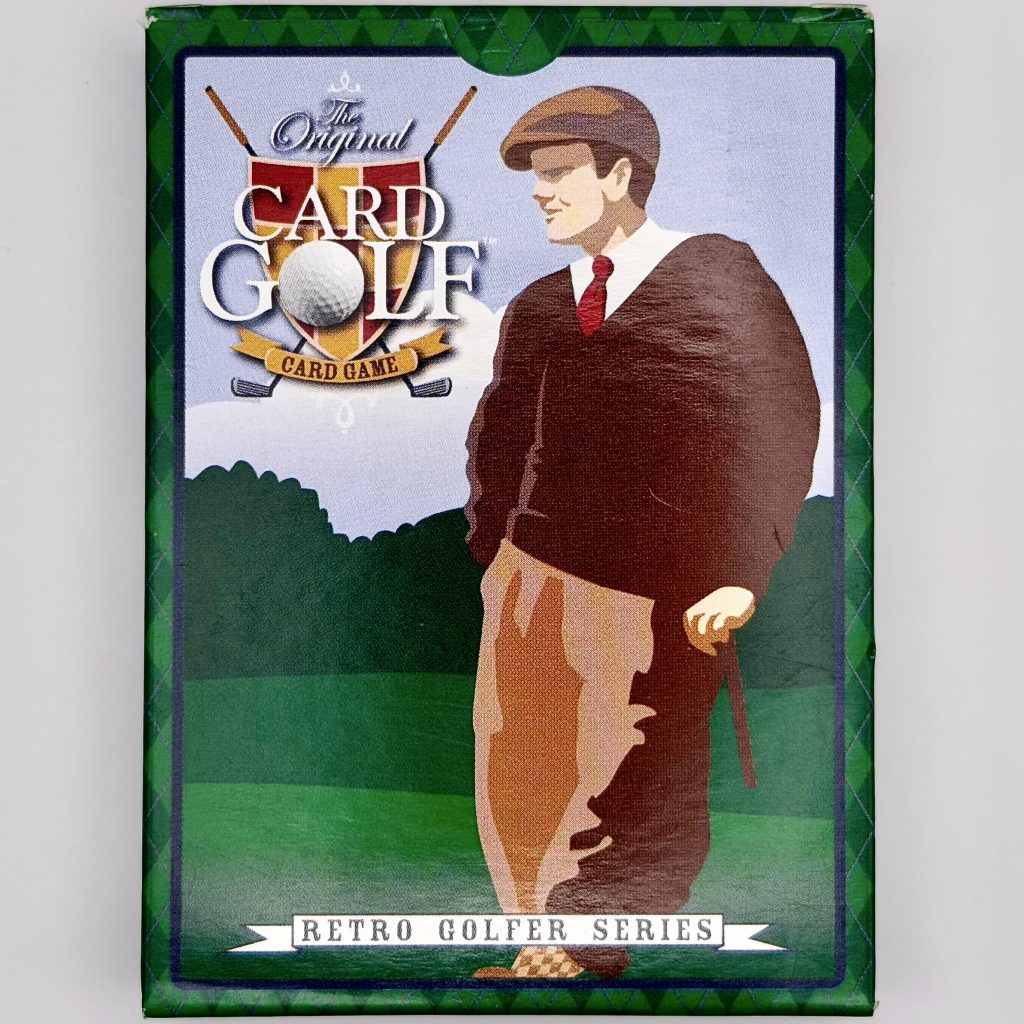
Who Made It?
The back of the box reads © 2006 Collaboration Reverberation, Inc., and points you to www.cardgolf.com for extra scorecards. And here’s where the detective in me hits a wall: there is almost nothing left online about a company called Collaboration Reverberation. It’s the kind of name that sounds like a band that played one show in 2005 and broke up. No BoardGameGeek trail I could confirm for this exact edition, no press, no story — just the object in my hands, stamped “Version 1” like they fully expected to make a Version 2.
One quick note to head off confusion, because I got tripped up myself: this is not the same game as the 1961 British “Card Golf” I wrote about earlier — that one was a Pepys deck where you could bunker your opponent on purpose. Same two words on the box, completely different game, forty-five years apart. In a niche this thin, names get reused a lot. The objects are how you tell them apart.
If anyone reading this worked on Card Golf, or remembers cardgolf.com, I’d genuinely love to hear from you. Everything below comes straight off the cards and the rules card — not a history page, because there isn’t one.
What Is Card Golf?
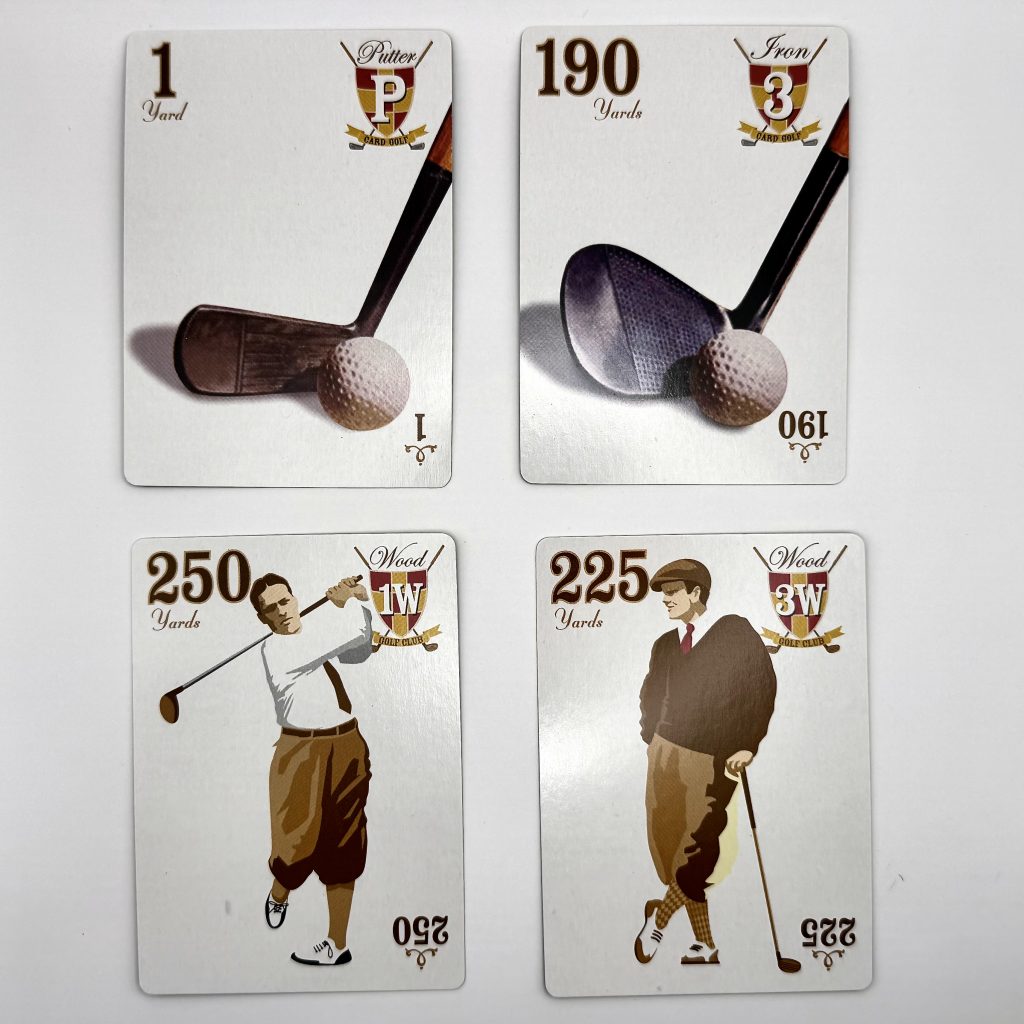
Card Golf is a 54-card deck where every card is a golf club with a yardage on it. A Putter is worth 1 yard. A 3-Iron, 190. A 3-Wood, 225. A Driver (1-Wood), 250. Your hand is a bag of clubs, and each club can hit exactly one distance.
To play, you grab any real golf course scorecard and read off the yardage for the hole. The sample card in the box runs a front nine of 567, 453, 213, 489, 432, 398, 475, 543, and 190 yards — a par-36 that would make your knees hurt in real life. Your job on each hole is to combine clubs from your hand so their yardages reach the hole’s distance — equal it or just barely clear it. You can go over. You can never come up short.
How It Plays
You start every hole with 14 club cards in your hand. Say the hole is 400 yards. A Driver (250) plus a 3-Wood (225) is 475 — that clears it, but you’ve overshot by 75, and overshooting has a cost (more on that in a second). Driver (250) plus a 3-Iron (190) is 440 — over by 40 in two clubs. Can you find a tighter combination? Maybe a Driver, a short iron, and a chip that lands you at 405? That’s three clubs instead of two, though — and here’s the tension of the whole game.
Each club card you lay down counts as one stroke. So fewer clubs is better — a two-club hole beats a three-club hole. But use too few big clubs and you’ll blow way past the yardage, which triggers penalty strokes. The box spells it out: overshoot by 1–5 yards, that’s 1 penalty stroke; 6–10 yards, 2 strokes; 11–15, 3; anything 16 or more, a flat 4. Your score on the hole is clubs used plus penalty strokes. Lowest total over 18 holes wins, exactly like the real thing.
So every hole is a little optimization puzzle: get to the number, clear it by as little as possible, and do it with as few cards as you can. It’s subset-sum with a 7-iron. And because the player with the lowest score tees off first — and refills their hand from the “New Club Card Pile” first — a good hole snowballs into a small advantage on the next one, just like momentum in a real round.
The Detail I Keep Coming Back To
It’s that “bring your own course” idea. Think about what it actually means: you can sit at your kitchen table and play the exact yardages of the course you’re teeing it up on this weekend. Play your home track the night before to get your head right. Play a famous course you’ll never afford in real life. Print a new scorecard, and the game is brand new again — no expansion to buy, just a different piece of paper.
It also puts Card Golf in the same family as a game I dug up from across the Atlantic — Augusta (1995), where every card is again a yardage and each hole is a target number to hit in as few shots as possible. Two designers, an ocean and a decade apart, landed on the same core instinct: golf is really just a distance you’re trying to reach in the fewest tries. Strip away the grass and that’s the math underneath the whole sport. I love that two people found it independently.
The Verdict
Card Golf is smarter than its plain little box lets on. The yardage-matching engine is clean, the “bring your own course” hook gives it near-infinite replay for the price of a printout, and the penalty chart keeps you from just slamming Drivers every hole. If you like a bit of arithmetic with your golf — and you don’t mind that the game leans on you to supply the scenery — it holds up well for something that quietly appeared in 2006 and then, near as I can tell, vanished.
What keeps it in my collection isn’t the rules, though. It’s that “Version 1” stamp and the dead web address on the back — the fingerprints of somebody who really believed they were starting something, and then didn’t get to. That quiet almost-story is exactly the kind of thing I go looking for.
Card Golf reaches a hole by adding clubs up to a number; I went the other way and stripped the round down to four cards. My version became Golf the Card Game — a fast rummy-style round with a Mulligan, a Fore! card, and Wild cards of its own. You can find it at playgtcg.com or on Amazon.
This post is part of our ongoing series exploring golf card games across the last century — the famous, the forgotten, and the ones that only left a box behind. Know something about Card Golf or Collaboration Reverberation, Inc.? Get in touch.