
Some games in this series came from frozen North Dakota or the mountains outside Melbourne. This one came from a place where golf isn’t a seasonal hobby — it’s a year-round way of life.
Putts & Drives Golf Card Game was created by Blugras, Inc. out of Sarasota, Florida — P.O. Box 51223, zip code 34232. Copyright 2003. 48 custom playing cards, printed in the U.S.A. The website (puttsanddrives.com) is abandoned. The email was a Comcast address. Another P.O. Box operation, another game that outlived its maker’s online presence.
But what Blugras left behind is one of the most structurally interesting golf card games in this collection — a game that forces you to build a complete golf hole from your hand, card by card, or pay the price.
The Mechanic That Sets It Apart
Most golf card games in this series are about getting the lowest score. Putts & Drives is about that too — but with a catch. You don’t just need low cards. You need the right cards. Every completed hole requires specific card types in your hand.
On a Par 3, you must hold exactly 3 cards at the end, and among them you need at least 1 Drive card and 1 Putt card, On a Par 4, you need 4 cards including a Drive, a Fairway, and a Putt.,On a Par 5, same requirements but with 5 cards. If you can’t assemble the required combination by the end of the hole, you get an automatic triple bogey — 3 over par.
That changes everything. In most draw-and-swap games, you’re just chasing low numbers. In Putts & Drives, you’re assembling a structure. You need the right pieces in the right combination, and every piece also carries a stroke value from 0 to 4, You want a Drive card — but you want a Drive with a low number. You need a Putt — but a P1 is better than a P4. The game asks you to solve two problems at once: build the right hand AND keep the total low.
The Deck
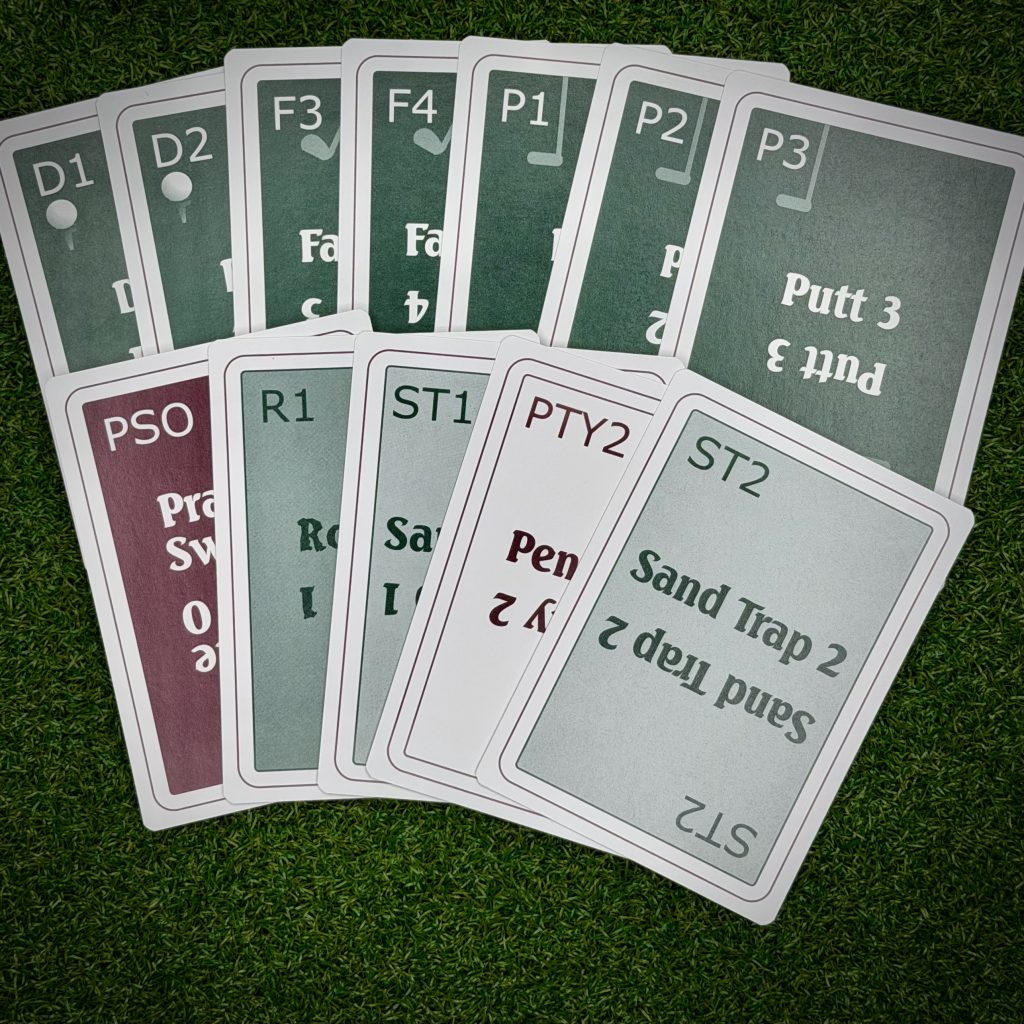
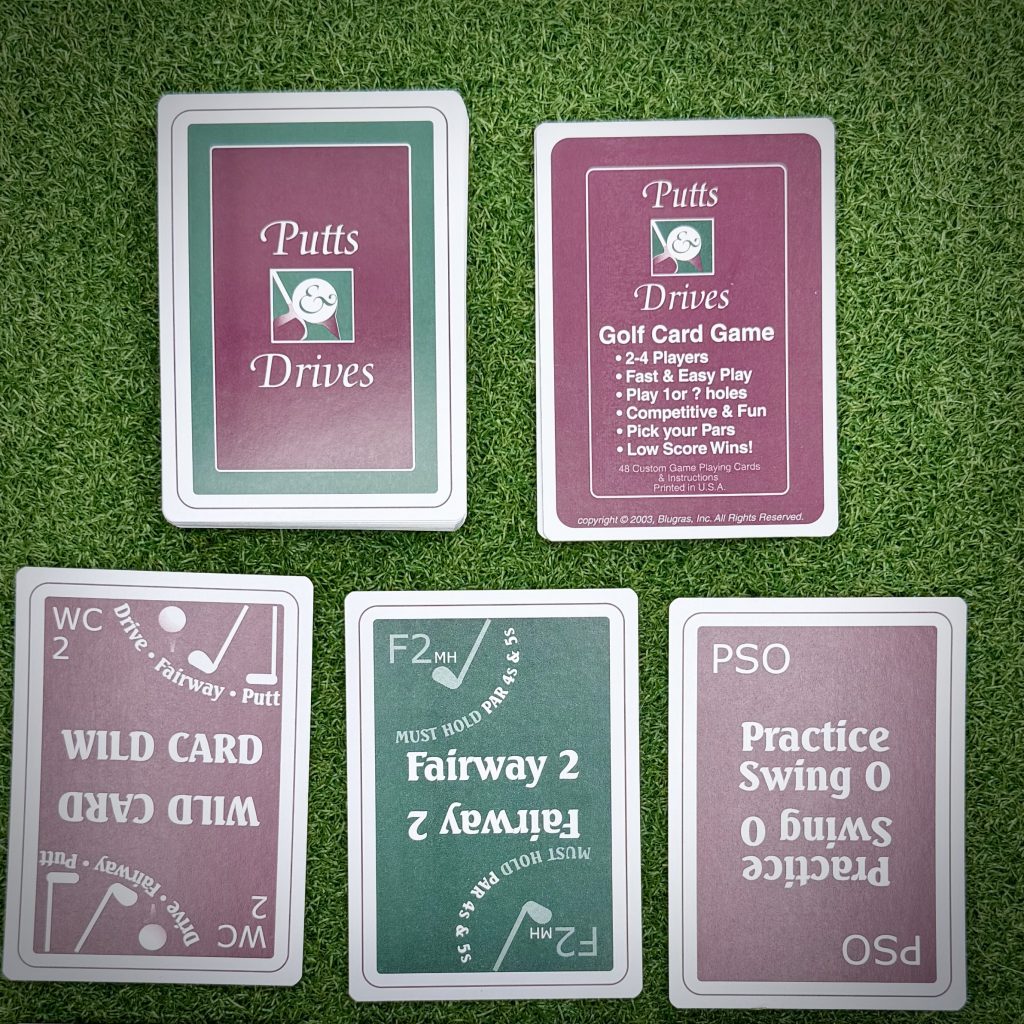
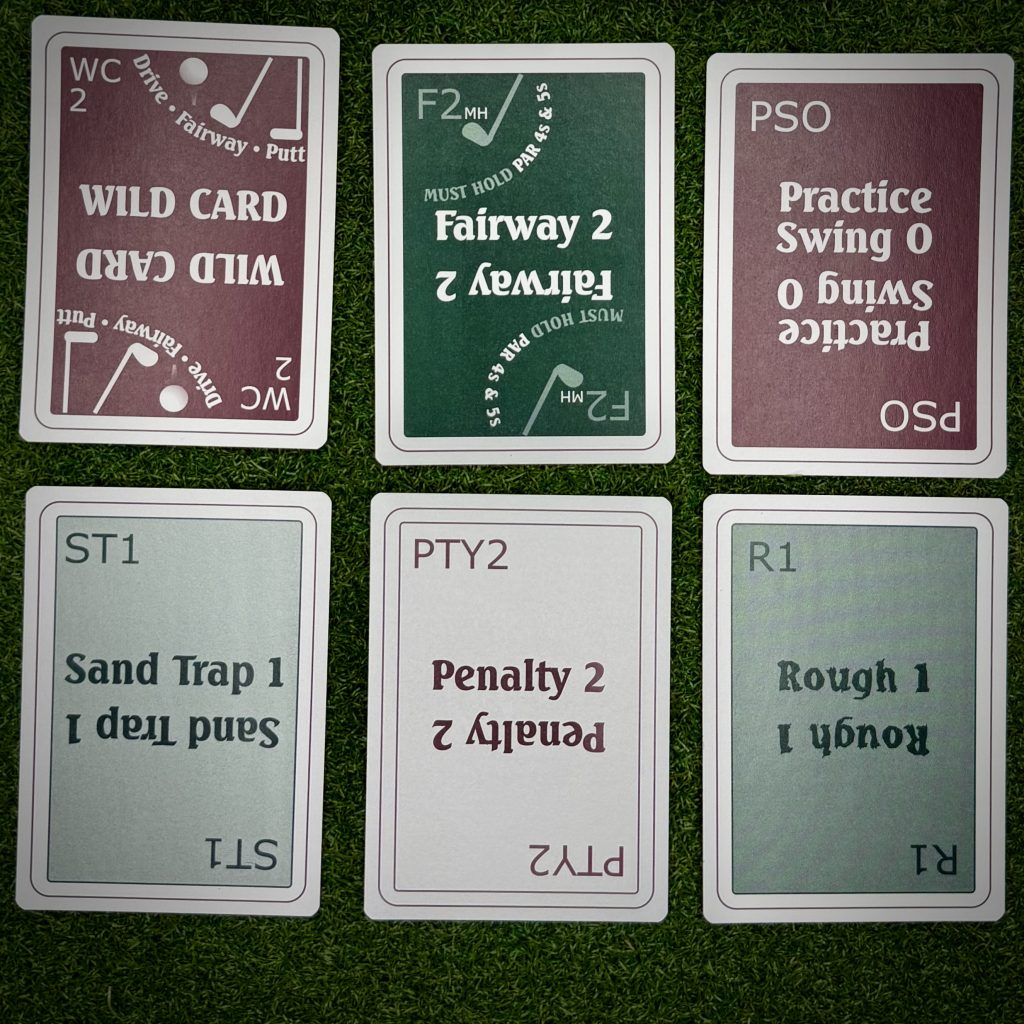
48 cards total, each with a shot type and a score value (0 through 4): 10 Drive cards, 12 Putt cards, 13 Fairway cards, 3 Sand Trap cards, 2 Rough cards, 2 Penalty cards, 2 Wild cards, and 4 Practice Swing cards (score value of 0 — they don’t add strokes but they do take up a card slot in your hand).
Two cards are designated as “Must Hold” cards — a D2 that cannot be discarded on Par 3s, and a FW2 that cannot be discarded on Par 4s and 5s. These locked cards add another layer of constraint. You might be stuck with a card you don’t want, but you can’t get rid of it.
The Wild cards can substitute for a Drive, Fairway, or Putt — but only one type per use. They’re your escape hatch when you can’t find the right piece to complete your hole.
How It Plays
The flow is structured and methodical. The dealer decides the par for each hole (or uses a real scorecard). Cards are dealt based on par — Par 3 gets 4 cards, Par 4 gets 5, Par 5 gets 6. You look at your hand, then everyone simultaneously discards one card. Then you draw one, look again, everyone discards one. Repeat. Then the dealer deals 2 more cards to each player, everyone discards 2. Finally, hands are revealed.
That simultaneous discard mechanic is unusual. Everyone acts at the same time, which speeds up play and creates a different dynamic from the typical clockwise draw-and-swap. You’re not watching opponents — you’re focused on your own puzzle.
Once a card is discarded, nobody can pick it up. No fishing from the discard pile. What’s gone is gone. That forces commitment — you can’t hedge by watching what other players throw away.
The Triple Bogey Penalty
Here’s where the pressure lives. If you finish a hole without the required card types — no Drive, or no Putt, or no Fairway on a Par 4 — you’re automatically scored at 3 over par. That’s devastating. But there’s a mercy rule: if you DO have the required cards but your total is still 3 over or higher, and another player failed to complete the hole, your score gets reduced to a double bogey (2 over). You’re rewarded for at least assembling the structure, even if your numbers are ugly.
It’s a clever system that creates a decision tree on every hole: do you prioritize finding the right card types, or do you chase low numbers and hope the structure fills itself in?
Sarasota: Year-Round Golf Country
Sarasota, Florida has been golf country since 1886, when a man named John H. Gillespie showed up with a bag of hickory shafts and built two holes near what’s now Main Street. Today, Sarasota County has over 30 golf courses — public, semi-private, and private — and the climate means you can play 365 days a year.
A golf card game coming out of Sarasota in 2003 makes perfect sense. This is a place where golf isn’t something you do when the weather cooperates — it’s always cooperating. Blugras, Inc. (a name that nods to bluegrass — the kind of grass on a putting green) was clearly born from that culture.
The BoardGameGeek listing describes Putts & Drives as “a great game for Golfers to place in their golf bags for those times when the weather pushes them off the course and into the clubhouse.” Even in Sarasota, it rains. And when it does, you’d better have a card game.
Finding One Today
Putts & Drives is extremely rare. The website is gone. The Comcast email is almost certainly dead. I found mine still shrink-wrapped — a sealed time capsule from 2003 Sarasota. If you come across one, grab it. The “Must Hold” card mechanic and the structural requirements make it one of the most distinctive designs in this entire series.
Building the Hole
Every game in this series solves the same problem differently: how do you put golf in a deck of cards? Putts & Drives answers it by making you build each hole from the pieces in your hand. Drive. Fairway. Putt. Without the right structure, you fail — regardless of your numbers.
Golf the Card Game takes a completely different approach — a streamlined 4-card game with the Fore! Card, Wild Cards, and the Mulligan mechanic, where the structure is built into the deck rather than the hand. But I respect what Blugras attempted in Putts & Drives. They didn’t just make you chase low numbers — they made you think like a golfer. Drive first. Then the fairway. Then the putt. In that order. Or pay the price.
If you know anything about Blugras, Inc. or the people behind Putts & Drives, reach out. We’re still mapping the full history of golf card games, and there’s a pin in Sarasota that needs a name behind it. Find us at playgtcg.com or on social media.
This post is part of our ongoing series exploring golf card games throughout history. From frozen P.O. Boxes to sunny Sarasota, the love of golf at the table has never faded.